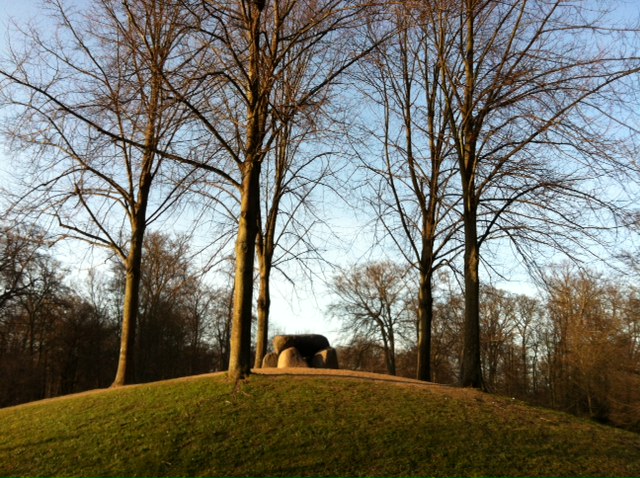
A house at the Frilandsmuseet in Copenhagen, displaying an impressive utilisation of thermal mass
Clicking around the peak oil blogosphere and reading about the Age of
Limits meeting that took place in the US last week has left me with a
curiously bewildered feeling. I'm not sure why, but it feels as if we
have entered uncharted territory of late, as if there has been a ratcheting
up of the general anxiety level and a tense atmosphere is hanging in
the air. Perhaps it's because everyone is talking about religion and
spirituality, rather than how many barrels are left in the ground.
I'm all for that, but I need time to think and to digest.
I really feel that when we look back from the vantage
point of the future we'll realise that 2012 really was the year when the latest stage of catabolic collapse began to get into full swing in the West. Here are just
some randomish facts and headlines from the last week that float to
the top of my mind as I sit here writing this late at night:
Petrol sales in the UK have dropped by 20% over the last five years.
The newspapers say it is because we are all driving more efficient
vehicles.
The Royal Bank of Scotland chairman told investors that share prices
would not go up again 'in investors' lifetimes'.
50,000 less students applied to UK universities this year compared
to last.
Thomas Cook – the UK's biggest and oldest travel agency –
announced a loss of £330m and its share price has dropped by 90%.
British Aerospace has cut hundreds more jobs.
Millions of people are facing a pensions shortfall.
Pay freezes and cuts are the 'new norm' according to a business
survey.
Capital flows are charging around the world looking for 'safe
havens'. 100 billion euros has been taken out of the Spanish economy
recently.
Part of the normal business cycle? I think not.
Still, I'm glad of one thing, and that's the fact that I 'discovered'
a new (to me) peak oil writer in Carolyn Baker. Sometimes, when I
read peak oil writers, I feel very humbled by the amount of
work they put into their writing and the depth of their understanding
of the issues that confront us - especially the more technical aspects. I, by contrast, am no expert in anything and this blog
is normally written at the kitchen table on a Sunday morning with the
kids running around me and the washing up piled nearby. It's hardly
ideal, but it brings me onto another subject that I have been
thinking about of late, and that is about where we live.
Yes, I'm talking about our homes. In Denmark, where I live, things
can seem a bit topsy turvey, to use a technical term. You can buy a
splendid old stone farmhouse in the country with acres of fertile
land for next to nothing – but a tiny flat in a city costs a
fortune. And what do you get in your flat? You get a lounge, a small
kitchen, a tiny bathroom and a couple of bedrooms. Of course, some
apartments are bigger than others and may or may not have a balcony,
but one thing that they all lack is space.
And I'm of the opinion
that we need space. We need space to make things in and space to be
alone in. What we actually get is a tiny amount of space to live our
just-in-time lifestyles in where hardly anything can be stored. There
is no space to run a small manufacturing/crafts business and children
are cooped up all the time and don't have the freedom to run around
and play boisterous and noisy games (if they attempt that within the
confines of their apartment they are labelled as having ADHD and
given Ritalin).
All of this makes perfect sense in an age when work is provided by an
outside agency for a salary, nobody makes stuff and children are
conditioned from an early age to watch TV and play computer games. It
also makes sense from an energy perspective – cramming all those
people together makes it easier to keep them warm for less energy.
But living in an apartment isolates you from nature, limits you
from being productive and, quite often, isolates you from your
neighbours (who you only speak to via the medium of complaining about
something or other).
So it made a nice change for me to head over to a part of the city
which demonstrates that this hasn't always been the case. There's an
area of Copenhagen, hemmed in by blocks of flats and motorways,
preserved as a kind of museum - called the Frilandsmuseet (meaning 'open air museum') in which all the houses are freely
available to explore. I can spend hours wandering around the place,
taking mental notes of the blacksmith's tools, the miller's stones
and the fisherwife's loom and bobbins and all the other things that are these days regarded as quaint artefacts from another age.
In its day it would have been a small hamlet, more or less self
sufficient in the basics and with perhaps 20 families living there.
A circle of stones was the community meeting point, with the head of
each family being sat on each stone in any discussion. The status of
each family was apparent in the intricacy of design work on items of
furniture and the quality of the house builds. The miller seemed to
be the best off family, with plenty of pious pictures on the walls
and the grandest house of them all. But then he was the one most able
to exploit the available primary energy sources – in this case wind
and water – and process the raw materials into a refined product.
Wandering around, I wondered just what it would have felt like to
live there in, say, 1800. Life would undoubtedly have been hard by
today's standards, but it would also have had its comforts. Also, I
wondered how self-sufficient, to use a modern term, the place would
have been and to what extent they would have traded with outsiders
for some of the fancier goods. A few of the dwellings are fishermen's
cottages, so I'd guess that a lot of their protein came from the sea.
That option wouldn't work today, with the Baltic being more or less
fished out as far as small-scale fishing from boats are concerned.
It's probably at this point that some people will think that I am
advocating a return to a medieval village type of existence and that
perhaps I'm a feudalist. I don't and I'm not, although I can't help
admiring the rural beauty and the elegant functionality of the hamlet
and its houses and all the tools that they left behind which hardly
anyone alive today knows how to use. Below you can see a few snaps I
took while I was there.
That's all I really have to say in this post. Sometimes the ink flows
and sometimes it does not. It's a couple of days earlier than normal
because I'm off for a wedding in Odense for the weekend. It's a half
Danish half Irish affair, meaning that it's going to be rather a late
evening.
On a positive note I can reveal that I have started talking with
someone who is selling five acres of mixed broad-leaf woodland which
even contains some old charcoal pits. I'm sorting out my future
'career' inch by inch …
The blacksmith's workshop
A hand cranked sewing machine
The smith's house at the Frilandsmuseet
The communal council stones. There were ten council members in the village - and presumably no tree back then
Some chickens in a wagon shed belonging to the miller's family
The miller's water wheel. The work that this is capable of is quite impressive.
The miller's windmill - cutting edge Dutch technology in its day
The village hall. There are also small rooms for travellers inside.
A fisherman's house - transplanted from elsewhere in Denmark and re-erected
A scullery inside one of the houses - the original Scandinavian designed kitchen
An article
published this week in a British newspaper revealed that scientists
say street lighting is having an accelerating effect on various
species because the extra light is interfering with both insects and
those who predate on them. This is hardly ground breaking news for
anyone who has watched a gecko hunt moths around a wall-mounted
external light – indeed when we run out of energy for unnecessary
lighting it will be a dark day (and night) for geckodom. Inevitably,
some of the people commenting on the article seemed to say that we
shouldn't worry about the effects our infrastructure has on nature
because nature will always evolve ways around it; natural selection,
and all that.
Whether
species can adapt to our more or less random behaviour seems pretty
unlikely to me given the extent that we have changed the environment
to suit our own ends and the speed with which we have done so. That's
not to say that nature won't eventually adapt – that's what nature
does – but given our insistence that we are somehow separate from
the natural bio patterns of the planet we evolved to live on, Mother
Nature might just agree with us and snuff us out entirely in the
medium term. I say the medium term because in the long term we're all
fried chicken, as Ugo Bardi pointed out in a marvellous essay this
week. Life, it seems, has about another 1.5 billion years to enjoy on
Earth before it ends. It won't be a sudden end – like when the
Vogons destroyed the Earth to make way for an intergalactic highway
at the beginning of the Hitch Hikers Guide to the Galaxy, but
equally, we can't say we weren't warned. Just like Arthur Dent, most of us will still be in our dressing gowns, metaphorically speaking.
So, given
that we are guaranteed not to last in the long term and are doing our
damnedest to make it harder for us and all of our fellow earthlings
in the medium term, the place to focus on would seem to be the short
term. What do I mean by the short term? Well, the next 1000 years
would be a good starting point. Let's imagine our actions today as
seen from the point of view of revellers in the year 3000AD (or
equivalent date, who knows what calendar system they will have?)
There are still likely to be the crumbling ruins of some of our
greatest cities and buildings there for examination by anyone
interested in studying life and civilization before the second Dark
Ages. By greatest buildings I don't mean things like skyscrapers,
which will have been dismantled for their scrap value, but more
longer lasting buildings made of materials that are difficult to
recycle and use for other means. Some of the grander neoclassical
imperial edifices may still be half-standing, such as the Bank of
England, the scattered remains of which will be visible to fishermen
peering into the shallow waters off the coast of a shrunken future
England.
It's
probably fair to say that most people these days don't think 1000
years into the future, and if they did they might picture flying cars
and holidays on Mars and all the imaginary perks of an industrial era
extended far beyond its shelf life. But as the chasm widens between
that imagined future and the one we have assured, which involves a much lower
level of accessible concentrated energy available for our use, I
wonder how many people are prepared to abandon that dream, and all
the hard psychological readjustment that this will take. I for one can
certainly remember being about 16, kitted out in some new Adidas
trainers and walking down the street listening to a tape of the
Beastie Boys on my Sony Walkman (Adam Yauch RIP) on a sunny day in Solihull. I
clearly remember the feeling that life, as I understood it, just
didn't get any better than this and that all of history had climaxed
to create the perfect moments like these. We had, I felt, drifted apart
from the messy realities taught in history lessons at school and could henceforth just enjoy cool gadgets - like my Walkman.
In
retrospect my outlook was as back to front as my baseball cap, but I
wasn't the only one thinking such thoughts. Indeed I may have picked them up subconsciously from the ether (alas my baseball cap was not lined with tinfoil) and it was only a year
or two later that Francis Fukuyama famously declared the End of History. Of course, he was about as wrong as it is possible to be,
but the 16-year-old me could relate to where he was coming from. Who will write the book entitled History's Just Getting Started?
***
Other
people
Last week
I wrote about one of the skills that will be necessary to negotiate
to turbulent waters ahead – that of learning to live without having to purchase so much stuff so that when the unwelcome reality of being forced to live with
less material comfort is forced upon us it won't come as such a
shock. This week I'd like to raise the novel idea of getting on with
other people.
If you
have had a peak oil epiphany in the last few years you will know
that, unless you are living in Micheal Ruppert's Collapse HQ, you
have to keep your mouth more or less closed in polite company.
Normally, to suggest that things are not ticketyboo (and then some),
you'll get that blank look in which the respondent is mentally
removing you from the compartment labelled 'Normal Guy' and refiling you in
the one that says 'Deluded Lunatic' - the same compartment in which David Icke and his Space Lizards are filed. Never mind that you have
spent literally years fervidly reading about economics, history,
ecology and psychology and every single one of them leads you
inexorably to the same conclusion that seemed so obvious in
retrospect – in the eyes of your interlocutor your opinion is less
valid than the one he shares with that bloke in the pub.
At this
point it would be tempting to give up and focus on getting something
done that you have a reasonable chance of achieving. That's all well
and fine, assuming you don't care about other people. But on the
other hand, when a close family member or a valued friend seems about
to commit the kind of terrible mistake you know could never end well,
it becomes a bit more difficult to bite your lip and keep schtum. On
the one hand you don't want them to pump their life savings into a
shale gas bubble but on the other you're worried that by warning them
they'll do it anyway and label you an interfering nutter to boot.
Given that
evangelism rarely works the only way I can see around this problem is
to effect changes in your own life and be a real-life example. That
is, I'm afraid, all we can do, and if your brother is convinced that
we'll all have mini thorium reactors in our backyards soon and that he is planning to retire on the income generated from his Facebook shares then I'm
afraid you'll just have to let him learn the hard way.
Nevertheless,
there are plenty of people out there by now who you could consider
'like minded'. They are scattered all over the place, in every
country, and the one thing they share is a resolve not to let the
scales be pulled over their eyes any longer. Hundreds more turn up
every day, tired of being spoon-fed fairy tales by the mainstream media
and driven perhaps by some inner sense that things are not going as
well as they have been led to believe. Indeed, the number of
peaksters is growing steadily and if they were a traded stock they would be
worth investing in as they are one of the few things growing these
days, apart from national debt that is.
The
Transition movement comes in for a fair bit of criticism from some
quarters, but to my mind it's one of the most hopeful things there
is. Critics say that it tends to focus on drawing up plans for a
transition away from fossil fuels and towards sustainability at the
expense of real action. But from the yelps of protest I have heard in reply, this
might once have been the case but it is no longer and in my opinion there are worse things you can do than join in with Transition.
As I
mentioned in a comment last week, I have seen a collapse happen up
close. It wasn't any great shakes in the scale of things and could
perhaps be considered a collapse-lite but it did involve lots of
people losing their life savings, a few cases of problems putting
food on the table and one or two suicides of people I didn't know
personally. Yes, this was the time I lived in Spain and the property
bubble burst in late 2007. Immediately put out of your minds any
thoughts of me living on one of the costas, soaking up the sun every
day on the beach and drinking sangria with a bunch of pink skinned
expats. Instead I lived in a large valley between two
mountain ranges near Granada called La Alpujarra. Considered one of
the most backwards regions of Spain, the place didn't even have a
supermarket – but what it did have was natural beauty and
resilience. Most of the foreigners living there got on extremely well
with the locals and it would be no exaggeration to say that the whole
area was 'alternative'.
Like most
people, we moved there so we could live a simple life. Property was
cheap and we bought a small ruined farm, which we did up and lived
in. I started a local community newspaper called The Olive Press,
specifically to campaign against the growing menace of plastic
greenhouses which were spreading across the landscape and threatening
to turn this small corner of paradise into a desert. Life was sweet
for three short years and we learned just how rewarding it is to live
away from the toxic culture of modern life.
When the
crash came most people couldn't believe it. Even the people living most simply suddenly found out how reliant they were on the property
bubble and I did not escape the carnage either. People suddenly
stopped being able to pay for advertising space in the newspaper and
we had to get a sales professional in, who took one look at our
operation and laughed. Out went the alternative therapy practicioners
and yoga teachers and in came the big full page adverts: banks,
airlines and estate agents. Similarly chucked out were any editorial
ethics and, inevitably, myself. I sold the newspaper to a tabloid
journalist and today, as one of the biggest foreign language
publications in Spain, it's a celebrity news soaked rag that claims
to be 'green' but in fact is nothing of the sort.
Anyway,
getting back to the point, when the crash actually happened the most
noticeable effect was that people who you thought were your friends
swiftly turned out not to be. We all know the type of loose
acquaintance I am talking about – the gossipy middle class types
who socialise widely and profess charitable intentions at every
opportunity. These, in my experience, were the ones to grow sharp talons very quickly and flee town, usually leaving a mess of
dishonoured debts and broken promises in their wake.
By
contrast, other people, the ones who really did help other people out
when TSHTF, are the ones who remain living there. They were the ones
with no money but plenty of empathy – and skills – to make things
carry on working. By joining together in solidarity and helping each
other out, each was able to bear the load a lot more lightly. A few
eggs and vegetables donated here, a visit and a cup of coffee there
and maybe even looking after someone else's kids for a few days so
they could take a temporary job and bring in some cash – all of
these actions, although small in their own way, prove to be useful
when added up. As cash becomes unreachable the barter economy is
right there waiting and every transaction becomes a reinforcing span
in the web of the community.
Of course,
a few morons exploited the system for their own ends, but the beauty
of a system in which cash is no longer king is that people by and
large stop doing business with morons. Said moron is then left being
unable to meet his needs and no amount of threatening language can
get him what he wants. That is why people are very friendly to one
another in peasant societies, such as the one we had inserted
ourselves into: rudeness becomes an unaffordable luxury when your
life might depend on your next door neighbour who just happens to own
the only winch capable of pulling you and your car out of a gulley.
This is a lesson lots of people are going to have to relearn in the
future.
***
Peak n'Oil
band Number #7
Simon and
Garfunkel
As
correctly guessed by Russell last week and befitting of this week's
post, Simon and Garfunkel are the band coming in at Number 7. The Boxer contains the unforgettable verse:
I have squandered my resistance For a pocket full of mumbles such are promises All lies and jests Still a man hears what he wants to hear And disregards the rest
And then of course what finer expression of the dominant sentiment of our popular atomised individualism could there be than I am a Rock?
And finally, the duo's rendition of Silent Night - 7 o'clock news reminds us that the backdrop to the lullabies we hear is the constant babble of the world's problems, which most of us would rather filter out.
Just some of the stuff thrown out by my neighbours in a single day
We live in
a throwaway consumer society, in case anyone hadn't noticed. It's
often said that people these days are more materialistic than in the
past, although that would seem to imply we had some kind of respect
for materials, which we clearly don't. I often feel like I am at the
epicentre of the throwaway consumer whirlwind, living, as I do, in
Europe's most wasteful country.
The
picture you can see above was taken this afternoon and represents
just a quarter of the stuff that was put in the dump area today not
forty paces from the front door of my flat. Tomorrow, lots more
stuff will arrive and on Monday morning workmen will put all of it in
a giant metal compactor and then it will be taken on a truck to the
local incinerator and turned into what the politicians here call
'green energy'.
In theory
all the TVs and bikes etc. will be sorted into different piles and
processed according to what they are composed of. In practice though,
most of it ends up in the same metal container along with everything
else. Luckily the prevailing winds are Westerlies so the trickle of
smoke that comes out of the incinerator will take it harmlessly away
out over the Baltic towards, er, Sweden.
I've
always been puzzled how anyone could throw a perfectly good thing
away. Growing up, it was hammered into me that you just don't waste
stuff. Thus my clothes were 'let out' (i.e. made bigger) by my mum as
I grew and we had the same knackered kitchen table with one leg
shorter than the other for decades. I also became an expert at
scraping the mould off the top layer of marmalade to get at the
'perfectly good bit' underneath – and was taught to judge whether
food was edible or not just by using my nose rather than looking at
some 'best before' date. Talk about lost skills.
I clearly
remember my first bike, which my parents gave me for my sixth
birthday. It was a bright red affair with solid rubber tyres and
home-made stabilisers salvaged from dead roller skates. My father had
cobbled it together from bits of other bikes and painted the frame
himself with some strong smelling oil paint. But if you think you can
detect an accompaniment of weeping violins as you read that then
you'd be wrong: we were a solidly lower middle class family with a
detached house in niceish part of town. That's just the kind of bike
you could expect to get in 1977, and I suspect some of my friends
were even jealous of my new chick magnet.
But
whatever you may think of home-made bikes and knitted mittens that
were attached by a length of string to one's duffel coat so that it
was impossible to lose them (a feature that delighted school bullies
everywhere) – not many people are actually willing to go back to
the 1970s. Here in the more bohemian parts of Copenhagen one could be
forgiven for thinking that we have returned to that era. In what
could be termed austerity chic, it's virtually impossible to walk
around Vesterbro without bumping into bearded, long-collared fashion
victims looking like extras from Starsky and Hutch. Some bars are now
decked out in the 'authentic' bad taste of the era replete with
yellowing wallpaper and smoke stained furniture. Of course, all the
clientèle are speaking on iPhones about their latest vinyl record
acquisition and drinking fashionable lager, so the illusion doesn't
hold up to much scrutiny.
Bang og Jensen - one of Copenhagen's most tragically hip bars has gone back to the 1970s
But I
wonder how many people in our very pampered societies are really
willing to go back to the 1970s – or beyond? As austerity begins to
bite and graduates start to get used to the idea that they'll
probably never get the job they assumed would be rightfully theirs at
the end of their studies, more and more younger people are having to
face up to the fact that their level of material wealth will never be
as great as their parents'. And then some.
All this
was a very circuitous and long-winded lead-in to what I promised to
talk about this week, namely, how to prepare for the coming energy
crunch and all the associated chaos. Here's a confession: I aim not
just to get through this mess alive, I intend to live through every
moment of it as best as I can. I hope to help any others who are
prepared to listen. To that end, this advice will seem pretty damned
radical to those who are new to the peak oil blogosphere, and grist
to the mill for anyone who has been paying attention over the last
few years.
I'm not a
fan of 'How to' lists, and neither do I like so-called advice dished
out by clueless experts or well-meaning amateur busybodies, so I'll
start by saying that the next few posts will be a collection of very
important pointers that I have arrived at after much consideration,
and ongoing consultations with many other people in the peak energy
scene. I personally try to live up to them all, and I'm fully aware
that the term 'hypocrite' can kill a well-meaning suggestion faster
than a silver bullet kills a vampire. To that end I'll be measuring
each of my suggestions against actions I have taken in my own life,
with the general aim being to communicate that if a lazy so-and-so
like me can achieve it, so surely can you. I stand by all of the
suggestions I make and, as you'll notice, I don't use a pseudonym and
am hence quite happy to take all the opprobrium I encounter from
others squarely on the chin. That's not to say that I think I have
'the' answer. There is no 'perfect' solution and I'm in favour of the
idea of dissensus i.e. a collection of different approaches to
solving the same problems as a more resilient and, to use a modern
term, open source way of doing things.
How to live with less
One of the
most important lessons for people to learn today is how to live with
less material goods than they have been led to believe is theirs by
birthright. In the West we gobble up resources at an alarming rate,
and people in former Third World countries are now copying us. But
for all sorts of reasons, the party's over. Here are some of the main
reasons:
Conventional
oil, which fuels our expedient lifestyles, has peaked. Forget dreams
of shale gas and Alberta tar sands – these are just shadow plays
concocted by investors and politicians and believed in by those who
want to believe in them. From now on, as we tumble down the far side
of the supply curve, we will see steadily climbing prices of
everything from food and energy bills to healthcare and technology.
Population
is continuing to climb, despite the fact that most people are
reliant on cheap forms of energy, particularly oil and natural gas,
to deliver calories to their bodies. This will not end well.
The
West is broke. We have lived beyond our means for too long. No
amount of money can compensate for a lack of cheap concentrated
energy. The East might be playing catchup with us, but they face the
same constraints on this small, finite planet, and will face the
same future.
Technology
will not save us. Everything from computing tablets to nuclear power
stations depends of processes which are highly energy intensive and
prone to supply disruptions, politics and financial bubbles. Some
technology will cushion our fall, but in the long run the industrial
civilization faces the same fate as every other former civilization:
a rapid deceleration in speed and reduction in the level of
complexity. Technology = complexity. Complexity = weakness. It's our
major blind spot: see it.
Given all
that, it's highly unlikely that we are going to see our standards of
material living increasing again in the future. So if we assume that
we have the choice between becoming poor voluntarily and being forced
to become poor against our will, which one shall we choose?
Consumerism,
despite what we are told on the adverts, doesn't really deliver.
There is plenty of evidence now that a certain level of material
wealth is optimal and when we get beyond this we start to become
unhappy. We humans are social primates, and when once we acquired
manufactured good to meet our material needs, we now seem to purchase
them merely to boost our individual status and satisfy the false need
that has been planted there by black magicians (aka marketers). The
point at which we drifted away from this optimal level of consumption
is beyond the memory of anyone under about 40.
The
pursuit of stuff is now our be all and end all, and we work on
consumer debt-powered treadmills to acquire bigger houses, better
cars, more exotic holidays and more up-to-date gadgets. This has
never occurred before in our evolutionary history, but so ingrained
has the idea become that some
people now faced with personal bankruptcy would rather choose suicide
as a way out rather than shake the demon of consumerism off their
back and lead a life that is actually worth living.
Does
anyone remember the first time they heard the term 'retail therapy',
meaning buying stuff you don't need as a way of halting depression?
In any other society in the world (and there are mercifully quite a
few left) this would simply be called 'insanity'. But these days it
is something to chuckle about – a guilty little pleasure akin to
eating a box of chocolates or watching your favourite film for the
umpteenth time. Similarly, people giggle that they are 'shopaholics'
in much the same way that people don't giggle that they are heroin
addicts or crack-heads. 'I went to Dubai for a spot of retail
therapy,' is a phrase I've unhappily heard uttered more than once.
In
America, and increasingly here in Europe, you are no longer given the
choice of becoming a consumer. If you want to 'get ahead' you're
encouraged to attend university and, ahem, study a discipline which,
increasingly, is some shade of marketing. Even if you don't study
marketing you might end up doing an MBA, meaning that you'll have got
yourself into debt right from the start of your adult life. A car
follows, as does a modest starter home filled with furniture from
Ikea - and before you know it you're trapped in career and saddled
with debt. This is known as being snookered.
But there
is another path you can take. It's not an easy one, but then nothing
truly worth doing ever is easy. This is the path of consuming less
and living within your means. It's not an attractive proposition
these days, and you'll likely lose a few friends and relatives along
the way. But you can take encouragement from the fact that plenty of
people are already doing it and having a fine time of it. Here are
some examples:
Mark
Boyle lives in the UK with no money. He lives in a caravan, brushes
his teeth with sticks and eats wild food and food that has been
thrown out by others. Read more about him here.
If
that sounds just a bit too hardcore, consider Jacob Lund Fisker, who
'retired' at around the age of 33 and lives off USD 7,000 a year
despite living a very full life in Chicago. He has an excellent blog
packed with advice on how you can do the same here.
And
the idea seems to be catching on, with a film being made about a
German granny who lives off no money at all after having become
'irritated with the greedy consumer society'. Read more about her
here.
Finally,
anyone can buy a starter home on a soulless estate, but it takes
courage and vision – and not having a 9-5 job – to build
something like this.
What the
people above have in common is that they rejected consumerism as a
path to happiness and instead chose to focus on their inner lives and
the things that made them truly happy. Things like learning to play a
musical instrument, building your own home, growing your own food and
learning new skills cost little or no money, but the paybacks are
huge and ongoing.
I myself
regard those above as aspirational and inspirational and I'll be
honest and say that because I have kids I probably can't get the
numbers down as low as they can. Nevertheless, everything everywhere
is a work in progress, and I'd like to work towards their example. In
my own life I have achieved the following:
Food.
At present, around half of the food my family consumes is
leftovers from the staff canteen where I work. A prodigious amount of
waste occurs here and I could probably feed myself and family quite
well on that alone. Of the rest, around 70% is organic – there's
not much point buying non-organic vegetables as they contain very
little in the way of goodness. About 95% of meals are cooked from the
raw ingredients, although we occasionally succumb to the supermarket
pizza. I'm 'mostly' vegetarian (since the New Year), although I don't
have a problem with eating meat – just factory-produced meat. I
describe myself as a 'part-time carnivore'.
I used to
grow a lot of our own food when we lived in Spain but now my options
are severely limited. There is a small balcony to our flat which gets
the sun from around 2pm, so there are some challenges. I grow
tomatoes and peas and this year I have a few pumpkins growing. I also
have a wormery there which handles most food waste and turns it into
compost. There is normally too much compost so I have to smuggle it
out of the apartment block at night time and dump it under bushes. We
are the only flat with food growing, with all others displaying
flowers, and I am frowned at for doing so. My next door neighbour, an
old woman, recently described me as a 'foreign pig' for the untidy
collection of food plants, which stand in stark contrast to her neat
rows of marigolds.
We almost
never eat out at restaurants or go to cafés or bars – it is simply
too expensive here in Denmark. With the exception of a cheap and
cheerful Chinese dim sum place I sometimes go to for a treat, the
only restaurants I end up in are the very high end ones. Why? Because
I carved out a niche for myself as a restaurant reviewer as a way to
get to go to these places. My enthusiasm for it has dimmed in the
last year or so, but in the past I have dined out at Michelin starred
eateries with aplomb. One memorable meal would have set me back
around USD 500 if I'd have paid for it – a fact I considered as I
ate a packet of noodles the next evening, coming in at around
1/1000th of the price but with a not dissimilar calorific
value.
Transport.
I go practically everywhere by bike, averaging around 100km per week
to work and back. We do possess a car, although I almost never drive
it. My wife regards the car as necessary for ferrying the children
around and most journeys it makes are less than 1km. Despite it being
the most economical car on the market, getting around 58mpg, it's
very expensive having a car in Denmark and, although I'm not against
car use per se, we plan to swap it for a cargo bike later this year.
In terms
of planes, I try and avoid them wherever possible. This hasn't been
possible this year but I hope to make my final plane journey within
the next year and stick to ground-based transport after that. I had
never been on a plane until I was 21, so I aim to have had two
decades of flying with them before quitting. Given that we plan not
to go anywhere outside of Europe in the future, it should be a simple
case of hopping on trains and buses.
Energy.
We live in a flat that was allocated to us by the council when we
were broke and as such have little control over the heating, which is
set for the whole block (too high, as it happens, and in Winter I
have to open the windows or else bake). We use about 5 kWh of
electricity a day, and most of this is used by the fridge and on
cooking. Wherever possible I use energy saving measures, such as slow
cooking with the lid on, putting devices on timers, maintaining the
fridge freezer etc. Clothes are washed at 40 degrees Centigrade and
dry on racks around the flat. Our electricity consumption is around
half the normal rate and we get a nice cheque back each year because
our billing is based on the average rate.
Stuff.
Nearly everything in our flat is taken from the dump I mentioned
above and our whole apartment is decked out this way. Most of the
stuff is nearly new (the microwave was still in its unopened box) and
the things I have rescued so far include: a pine table at which I am
now writing, an espresso maker, three TVs, numerous frying pans and
dishes, chairs, two beds, several computers, bookshelves, plant pots
(with plants), some expensive designer chairs, lots of artworks, a set of weights, two grandfather clocks, several bicycles, a wood-turning lathe, two seal skins, some giant
wooden cats (that hold CDs), a set of Dickenses printed in 1907,
numerous stereos and DVD players and a sewing machine. Many of the
kids' toys are similarly from the dump and they often accompany me on
my forays, regarding such outings as completely normal. I've even
found a bag of silver cutlery there, and a plastic bag filled with
coins, and a complete wine making set from the 1960s – there really
is no end to the treasure one can pick up there.
Clothes.
I wear my clothes until the literally fall to pieces. Some of my
socks are 20 years old and still going strong. Part of my reason for
this is that I hate clothes shopping. After about 10 minutes in a
clothes shop I become dizzy and nauseous, so I try and limit the
experience to around once or twice a year if I really need something
for some reason.
Holidays.
The last few years we have taken our holidays in other people's
houses while they came to live in ours. House swapping is an
excellent – and free – way to have a holiday and we've been lucky
enough to have had several breaks in rural France, taking the
overnight train to get there. This year we are going to stay on a farm in Greece - our first 'proper' (i.e. paid for) holiday in about six years.
Leisure.
Many people buy expensive gear to be able to pursue some kind of
leisure activity such as kite surfing or boating or scuba diving. My
leisure activities tend to consist of reading and going for walks. It
might sound corny, but I can get far more pleasure from watching a
beautiful sunrise on the beach, than I would by doing something that
required me to buy a load of gear or, gods forbid, join a group of
like-minded enthusiasts. That said, I do love photography, and
building things. And cooking, and lots more.
Personal
grooming. My wife cuts my hair for me and we make all our own
soap. I made a pot of shaving soap two years ago and it is still only
half finished. I'm also working on making shampoo, which is getting
increasingly expensive.
Conclusion.
Many people would read the above and no doubt find fault with some of
my choices, but for me I am quite happy to be continuously reducing
my consumption footprint. Many others will no doubt think that this
is too severe and that I should 'live a little'. The thing is, I live
more than a little, I actually consider that I live a lot without
attending expensive concerts or sporting events or going on costly
trips to holiday resorts. Instead of spending money unnecessarily we spend it on things that we consider of much greater value - including holidays.
The amount of money we actually spend every
month is far below what is considered the poverty level in Denmark
(you are officially 'poor' if you have less than 8,450kr in your
pocket every month after tax – that's about USD 1,450) and yet we
count ourselves as amongst the richest 1% on a global scale –
something to bear in mind when assessing how 'monastic' one might
consider oneself to be.
*** Update - in response to several comments people have posted about the above on other websites I should probably clarify that I DON'T regard scavenging as a way of living in a post industrial future. I should probably have stated that it can only be useful when there is a surfeit of 'waste' generated by a consumer system in overdrive and that by taking what's there for free out of the waste stream you can spend your hard earned on more useful things like books and tools and insulation. Neither do I dress in rags and feed my children swill from a bucket. Sometimes things can get exaggerated a little ...***
Peak
n'Oil Band Number #8
Led
Zeppelin
An easy
choice for this week. In the realm of rock anthems about consumerism
as a substitute for something more meaningful Stairway to Heaven
can't be beaten. There are probably plenty of other Zeppelin tracks
that address meaningful peak oil realted subjects too, but the only
one can think of right now is When the Levee Breaks.
Perhaps
it's just me, but over the last couple of weeks I thought I could
distinctly hear the sound of pennies dropping as an ever growing tiny minority of people began to realise just how godawful our situation
has become. It could have begun last week Sir Mervyn King, the chief economist at the Bank of England, – a staid economist not given to
wild statements – casually said that our economic situation outlook
was likely to be worse than the Great Depression.
He was, of
course, immediately rounded on for being alarmist, not least by the
Guardian's chief economic fantasist Will Hutton who, yet again,
insisted that financial mismanagement was the cause of all crises and if only everyone just followed his prescriptions for caring capitalism we'd be all be fine. In
another post Mr Hutton claimed that the future lies with Japan
because they have more caring electronic gizmos than anyone else - including heated toilet seats. Quick, somebody call a nurse!
And
there's no point looking for answers with any of the Left's other
supposed gurus either. Nobel Prize winning Paul Krugman doesn't get
it either, and insists that some mix of Keynesian stimulation is all
that's needed to get those consumers consuming again so that we can
rejoin the path to a lightweight knowledge economy … or something.
What else can the Left offer (I'm not even going to bother considering what the Right consider as solutions - from their point of view there's little wrong with the system in the first place)? Oh yes, the 99% and all that. Kill the bankers and redistribute the wealth. Occupy. Revolution. I'm sorry chaps, I don't think that's going to work - no matter how evil you think the '1%' are (there's the clicking sound of me losing another dozen Twitter followers).
Keynes
once famously prescribed paying a man to dig a hole and paying
another man to fill it in again. I'm all for that if there are holes that need digging and filling (or more useful tasks, such as insulating homes), and much as I like Keynes the person, I think this time we should sling him into the hole too before it is filled in.
Back in his day the stated macroeconomic policy goal was full employment – and when was the
last time you heard that term used? A more apt question today might
be 'who is going to pay those hole diggers?'
Anyway,
back to the fear. Does anyone know what a permanent
economic contraction feels like in a system that has no reverse gear? It means there is no point saving
for a pension because whatever money you put aside now won't be worth
much in the future. It means that governments can't borrow money at
anything like the rate they have become used to which means they won't have much money for things like schools and hospitals. Who would lend a
government money in the knowledge that it can't pay it back? The same
thing goes for banks. Of course, the current madness sees the endless recycling of unpayable debts between governments and banks, and until someone devises a new kind of financial
tool whereby banks can lend money and then be happy with only getting
half of it back again then I'm afraid we are heading towards total
paralysis.
Furthermore,
the countries that have racked up massive debts are now drowning in
them. Greece could well be the first to sink beneath the waves, but
there are plenty of others that could follow it. They can't all, as
some have suggested, just do an Iceland and refuse to pay, although
eventually many might be forced to do just that. Remember: in capitalism failure is not a option. And in case anyone
hasn't noticed, here in the West we are printing money like it is
going out of fashion (although the euphemism employed is 'Quantitative Easing'). Printing money, as anyone with a history
textbook knows, is a short cut to economic ruination. Yes - ruination.
Yet, so far, even QE has had no effect, with the Bank of England even giving
up on the idea – not because we are out of the economic straits,
but because it just doesn't do anything useful other than inflate the
balance sheets of a few financial institutions who, in turn, refuse
to recycle it into the real economy of goods and services in which actual humans live.
Of course,
the financial press can't ignore all of these problems, but they are
not exactly being given the prominence they demand, preferring
instead to focus on (i.e. cheerlead) the latest pump and dump
operations – be it Facebook, Apple or shale gas. A lot of reporting focuses on the individual actors involved, rather than the forces driving the dysfunction. Bad idea.
And that's
just the economic news, which is the most fixated-upon, but all-told
probably the least scary.
The very
few people I know in person who actually read this blog might chuckle
a bit and think that I'm being a little eccentric or alarmist in my
tone. The fact is that this blog is not nearly alarmist enough. By rights it should be written in a
bold 72 font with a flashing red background and a continuous air raid
siren noise playing in the background. After reading it you would
want to hurriedly gather a few belongings and family members, bundle
them into a car with the boot filled with dry food items and head
immediately for the largest gathering of like-minded people you could
find in some place far from history's flashpoint areas.
Because
the real problems we face are several fold and no matter how deeply we bury our heads in the sand they're not going to go away. The problems are so big they're not
even problems at all, they're predicaments i.e. something that we'd
better learn to adapt to asap rather than solve. The biggest one of
them all is overshoot. As a species we have overshot our resource
base by a factor of about seven, meaning that if you took away the
oil then the Earth's life support systems would quickly turn six
billion of us into compost. Oil, by the way, has plateaued and can
only go down from here.
And
people, by and large, can normally be relied upon to resist being
turned into compost, preferring instead that some others take on that
honour. There, did that sound alarmist?
So if we
can't eat oil what else can we eat? Well, the oceans are being
denuded of fish at an ever increasing rate, so fish is increasingly
off the menu. I once harvested and barbecued a jellyfish, just to see
if it was edible, and the result was a little bit like tough burned
rubber. After all, there is no shortage of jellyfish and they have
plenty of protein – but not many people were willing to give it a
try at the time (despite some nice barbecue sauce and chilli
dressing). I wrote about it in a newspaper and the only response was
from a vegan who said that jellyfish were sentient beings too. Hardly a ringing endorsement.
Topsoil is
being turned into chemical, salty dust at a breakneck speed too, and
aquifer levels in many regions are sinking fast so there isn't even
enough water to keep alive the nutritionally deficient monocultures
we have become so fond of. How are we going to cope with these
challenges? GMOs will just make things worse. And, no, as far as we know crops cannot be grown on the
seabed or, on giant floating sky islands or the Moon.
And just
when that sounded like enough challenges, we have the added bonus of
the fact that we are moving into an age of climate instability, which
is likely to see much of the world's fertile land and coastal cities
swamped by rising waters.
Of course,
if you are from China or India or any of the other supposed 'booming'
countries you'll a) Not be reading this in the first place despite me
putting a translation widget at the top or b) Will have covered your
eyes and ears by this point as you fumble for the mouse and tune into
some other blog which breathlessly discusses the amazing
diamond-encrusted future that awaits as you assume your position
as heir to the industrial throne. Good luck with that!
But, of
course, fear is not a useful response to our predicament. It can be a
useful reaction when, say, a wild animal jumps out from behind a tree
to attack you – the adrenaline rush allows us to move more quickly
and make better snap judgements. But as far as the long, slow arc
of the end of the industrial age and the twilight of the West is
concerned, fear is practically useless. Instead it is far better to
understand the challenges we face, and mentally and physically
prepare yourself for it. That's what I aim to start talking about in
next week's post.
***
Peak n'Oil
– Band Number #9
Fleetwood
Mac
Tell a man
something he doesn't want to hear and he'll ignore you – but tell
him something he does and he's all ears. Every time you hear a
politician promise to get [insert country here] working again, or you
see a shale gas commercial saying the stuff can provide our energy
needs for decades, or someone insists that we invaded
[insert oil soaked country here] to liberate them – just imagine
Fleetwood Mac's Little Lies playing in the background - it's a useful meditation in an otherwise depressing situation.
And given
that this week's post is about fear, there can be few better track
about it than I'm So Afraid. Remember, fear is never a good option,
but if you're feeling somewhat down as you scan the news on EnergyBulletin you could do worse than to play this track and turn the
volume up to Number 11.
Am I living in LaLa Land? That's a question I ask myself every day when I awake because whatever crises that are unfolding in the world at large they are rarely mentioned here in Denmark. You can have both financial and nuclear meltdowns and all the time it all seems like some faraway dream, only mentioned in passing on the news because they had some spare airtime to fill after all the slots about teachers wanting slightly more pay, and kindergartens looking at a staff shortfall of 0.3% by 2020, possibly.
Sometimes I have to pinch myself. Is it me dreaming or is it everyone else? Denmarkland, you see, is populated with the world's happiest people, and everything here is the Best In The World - it must be because we are told that on the news practically every day. Or occasionally second best (after arch-rivals Sweden). Nothing is ever allowed to disturb the flow of good news here, which is kind of ironic in the country where an awkward man who felt like he didn't fit in wrote a story called The Emperor's New Clothes.
In this country nobody is poor. Nobody is rich either (in theory, at least). Everybody has a high standard of living. Many families have second homes - usually here in Denmark but often in far-flung places like Thailand. A woman I know played a round of golf there last weekend and said it is best to go for a whole week but that it was not too far for a weekend break. Thailand! I once saved up for a whole year to go there and 'find myself'.
Here, your life is mapped out for you from the cradle to the grave and is done so by means of welfare. When you are six months old you go to nursery school. You then go to primary school, followed by proper school which, confusingly, is called gymnasium. Then, usually, you go to university (remember, most are middle class), which lasts for up to about 12 years and is normally rounded off with a PhD in something obscure but usually related to Denmark's big money earners: pharmaceuticals, IT, engineering and design. Then you have a stint known as your 'working life' which brings you up to 60ish, upon which you retire to a golden nest egg.
If, at any point during your working life you have the misfortune to find yourself unemployed, you don't really need to worry. Despite having no job you can still look forward to about 12,000 kroner a month courtesy of the government (that's about $2,100 after tax).
Some people retire early- like when they are 30. This is called 'before-time-pension' and is usually awarded to people who have had something traumatic happen to them, like a car accident, or if they are stressed at work. There are currently about 245,000 people on this - or about 7% of the working population.
All this adds up to make Denmark one of the happiest places in the world. People walk around with wide grins and proclaim that they could never live anywhere else because nowhere else matches up. To suggest otherwise is taboo, as I have once found out. And there are some good historical and cultural reasons for this which I am not going to argue with at all.
In fact, it's not my intention to rant about the country where my daughters were born, or where my life was saved when I suffered acute peritonitis or indeed where I took advantage of the generous welfare scheme as I worked my way through most of the books on my shelf that I had put off reading. No, that's not my intention at all (although gods know I've done so in the past).
Instead I just have one question: who is paying for all this?
It's a simple enough question: who pays for a lifetime of welfare and one of the highest standards of living in the world in a country that, basically speaking, has almost no natural resources, a smattering of light industry and the highest taxes in the known universe?
This is not a question most people would be willing to have a go at answering. But I'm just wondering about the gap between reality and the perception of reality here. Denmark, after all, was one of the few - perhaps the only - country to take oil shortages seriously in the 1970s. Could it be that in the intervening years a culture of schadenfreude has developed - a kind of ingrained 'resting-on-ones-laurels' attitude?
I suspect, after a decade of observation, that the true answer is much more complex and murky than that. For now at least, investors are pumping money into the country as it is seen as a safe haven. But how long can this last? I'm just wondering.
But in the meantime I have to try and convince myself that I am not going insane. Please, somebody tell me that there are actual problems out there in the real world and that all the smiley happy faces I see everywhere, and all the TV talk of Denmark avoiding 'the crisis' as they call it, and the suggestion that the most salient news event of the year so far was that cruise ship turning over off the Italian coast - please somebody say that it's not me that is going insane!
*******************
Peak n'Oil
In each post from now on, in a countdown from 10, I will be introducing a Peak Oil rock band.
Have you ever listened to a piece of music and thought: 'Wow, that perfectly expresses how I feel about peak resource production and some aspect of the likely ramifications on our wider society that are likely to ensue'? I thought as much. This, then, is my Top Ten of rock bands spanning the last 40 years or so who tell it like it is regarding mankind's follies when it comes to energy expedience, rampant consumerism and our vapid, empty and entitled way of life.
Why rock music? Because, just like science fiction, rock music has a way of getting to the core of important matters. It vents our fears and anguishes and gives voice to the power of the soul in its indignant howling rage. As such, it is probably the only modern form of music that is unafraid to challenge the status quo, albeit in a safe 'free speech' type of zone.
[Don't worry, there will be no actual Status Quo in in the Top Ten]
Please note that all these selections are taken from the shallow pool of my own CD collection, which effectively mirrors my own lifespan of the last 40 years (plus a few extra - I was 'retro' before the term was even invented) - if you'd like to add your own choices feel free in the comment section.
So, without further ado:
No 10. Julian Cope of the Teardrop Explodes
As a once legendary imbiber of consciousness altering drugs, Mr Cope makes it into the Top Ten by virtue of the fact that he wrote the song World Shut Your Mouth, which contained the lyrics 'put your head back in the sand and shut your mouth'. Clearly Cope, who went on to become one of the foremost modern-day scholars on Megalithic remains in Europe, was thinking of the blanket refusal of the modern world to take serious matters, er, seriously when he wrote those lyrics.
Despite being a pagan, a blogger and a scholar of the antiquities, Cope still found time to go solo and release several albums, including Autogeddon- an album about the fate that awaits us if cars are allowed to dominate our lives. It includes, seemingly, a reference to killing an SUV driver with a rock and is clearly the stuff that more people should have listened to while they were growing up in the 1980s.
If you like Julian Cope's music, you'll possibly like his history documentaries about ancient Britain.
In this
week we have seen two events that might in the future be seen as
small way markers along the path in the direction we are heading. The
first one, close to home, was the sudden bankruptcy and cessation of
Denmark's de facto national airline Cimber Sterling. The news, when
it appeared on Thursday morning, came like a small black swan (let's
call it a black duck) and shocked passengers at the airport were duly
interviewed, with most of them standing forlornly beside their
luggage with 'what am I supposed to do now?' attitudes.
The second
event was on the other side of the world in Japan where it has been
reported that the last of the country's 50 nuclear reactors has now
been taken offline, with no realistic prospect of being reconnected
in a country still dealing with the legacy of the meltdown at
Fukushima. Plan B, as far as the Japanese are concerned, involves
importing huge amounts of oil and gas to make up for the electricity
shortfall. This can hardly be seen as a long term strategy for any
number of reasons and is a timely reminder that our menu of energy
options boils down to no more than a few dishes of the day.
If, like
me, you regard events such as these as ever-mounting evidence of a
growing crisis in the industrial world for which we are wholly
unprepared, then the next logical step would seemingly be to prepare
ourselves for the inevitable. Using the analogy of a large ship that
is sailing towards an iceberg, we can either don our life jackets and
stand ready by the lifeboats (having failed to convince the captain
of the danger), or else pretend not to see the clearly visible
icebergs looming in our path and instead carry on knocking back
tequilas at the bar six decks below. Such measures, in the real
world, might involve building as many useful skills as possible in
order that we are not totally caught short when delicate supply
chains shatter, or building greater community bonds so that you can
take advantage of the division of labour when the energy slaves
suddenly perish. There are certain practical things that you can do
as well to ensure a relative degree of comfort for yourself and your
family, such as planting a garden and insulating your house.
All of the
above could be considered wise moves for those who, as Dmitry Orlov
puts is, are not interested in sitting in the dark wearing dirty
clothes wondering what went wrong. But taking the whole thing a stage
further than the merely practical we could do ourselves a favour and
build some resilience into our attitudes and the way we think about
things and relate to the world. This makes sense from several
perspectives. A problem, unless it is life threatening, is accorded a
severity based on our perception of how serious it is. And in an age
when problems are rushing towards us like an army of orcs in a Lord
of the Rings movie, it would seem only prudent to adopt as many forms
of defence against them as it is possible to muster.
It was
with this in mind that I recently read a copy of John Michael Greer's
latest book Mystery Teachings from the Living Earth. Now, I'm
not going to say that this is a book review because a) I'm not at all
qualified to review such a book and b) It could never be because to
review a book you must at least maintain a façade of detached
objectivity and anyone who has read this blog would simply not
believe me if claimed that to be so. Furthermore, the book is
primarily concerned with the mystery teachings, which have been
studied and practised by mankind down the ages, and as such they
can't be 'analysed' as such in a purely intellectual manner. So,
instead, 'll just say what the book is about and what I got from it.
My
background is about as non-spiritual as the next average Joe. I
wasn't raised as a Christian or a Jew or a Muslim. I wasn't even
raised as an atheist, and can probably count on the fingers of both
feet the number of times I have ever been in a church that wasn't a
school trip, a funeral or a wedding. In fact, like the overwhelming
majority of people in the UK, I was raised as a kind religion-less
materialist and the only kind of salvation or goal worthy of pursuing
that was ever suggested to me was to 'make it' in the City or
somewhere.
Nevertheless,
I wasn't entirely without the feeling that there must be more to life
than two flat dimensions and I do remember at an early age having a
strong feeling that purpose of life must be to gaze in awe at the
wonders of the universe. If that sound pretentious, I'm sorry, but
it's the only way I can describe it. I'm not sure where that feeling
came from, but it could have had something to do with my mother, who
was a quiet spiritualist with a firm conviction of there being
'something more' based on an out-of-body experience she had had a
small girl when she had 'died' from middle ear disease and was able
to watch her sobbing parents and the frantic doctor from somewhere up
near the ceiling. This must have struck a chord with me and a latent
spirituality manifested itself in me around the age of 30 when,
having read practically everything Alan Watts had ever written, I
found myself drifting towards Buddhism. But any progress on my path
to Nirvana was halted when I met a visiting lama in Copenhagen and
was revolted by the sycophancy of his acolytes and their 'holier than
thou' attitude. Buddhism, it suddenly seemed, was all about amassing
karma by giving silk scarves to important people and elbowing others
out of your way to do so.
Nevertheless,
there were many good and useful things in Buddhism that have stayed
with me and one of them is the idea that true transformation comes
from within – and that this requires a lot of work. This, it turns
out, is one of the core messages of the mystery teachings, and John
Michael Greer explains their Seven Laws using the language of the
science of ecology. By doing so he is repeating a tradition of
presenting their teachings in a language that people in the modern
age can understand. In ancient Greece, Plato taught them using the
language of geometry, which was the hip science of the age back then,
so Greer is translating them to language that we can readily
understand.
Greer is
also interested in correcting what he sees as a gaudy
over-commercialised and watered down version of the mystery teachings
and spiritualism in general that has mushroomed in recent decades,
taking particular issue with the idea that positive thinking can make
you financially rich and/or have any other effect in the material
world of our everyday lives. Similarly, he is not impressed by any
New Age 'airy fairy' insistence that we are all heading into a new
Age of Aquarius via some form of apocalypse or rapture or mass
rebirth of consciousness. The kind of transformation he has in mind
requires a lot of practice and is hard work but ultimately much more
rewarding.
The book
is split into two sections with the first being an explanation of the
Seven Laws of the mystery teachings explained through the language of
ecology and the second being about how to use these teachings in your
everyday life as a kind of psychic defence against the kinds of
predicaments I mentioned above and a way of making sense of the
universe on a level deeper than a purely intellectually rationalising
basis. At the end of each section is a meditation exercise, an
affirmation and a theme for reflection.
The Seven
Laws are explained at some length, each with the analogy of a meadow
with its various populations of field mice, snakes, birds of prey and
plant species. They are set out as follows – with the explanation
of each being taken directly from the book:
1 – The
Law of Wholeness. Everything that exists is part of a whole system
and depends on the health of the whole system for its own existence.
It thrives only if the whole system thrives and it cannot harm the
whole system without harming itself.
2 – The
Law of Flow. Everything that exists is created and sustained by
flows of matter, energy and information that come from the whole
system to which it belongs and that return to the whole system.
Participating in these flows, without interfering with them, brings
health and wholeness; blocking them, in an attempt to turn flows into
accumulations, causes suffering and disruption to the whole system
and all its parts.
3 – The
Law of Balance. Everything that exists can continue to exist only
by being in balance with itself, with other things, and with the
whole system of which it is a part. That balance is not found by
going to one extreme or the other way by remaining fixed at a static
point; it is created by self-correcting movements to either side of a
midpoint.
4 – The
Law of Limits. Everything that exists is subject to limits arising
from its own nature, the nature of the whole system of which it is a
part, and the nature of existence itself. Those limits are as
necessary as they are inescapable, and they provide the foundation
for all the beauty and power each existing thing is capable of
manifesting.
5 – The
Law of Cause and Effect. Everything that exists is the effect of
causes at work in the whole system of which each thing is a part, and
everything becomes, in turn, the cause of effects elsewhere in the
whole system. In these workings of cause and effect, there must
always be a similarity of kind between an effect and at least one of
its causes, just as there must be a similarity of scale between an
effect and the sum total of its causes.
6 – The
Law of the Planes. Everything in existence exists and functions on
one of several planes of being or is composed of things from more
than one plane acting together as a whole system. These planes are
discrete, not continuous, and the passage of influences from one
plane to another can take place only under conditions defined by the
relationship of the planes involved.
7 – The
Law of Evolution. Everything that exists comes into being by a
process of evolution. That process starts with adaption to changing
conditions and ends with the establishment of a steady state of
balance with its surroundings, following a threefold rhythm of
challenge, response and reintegration. Evolution is gradual rather
than sudden, and it works by increasing diversity and accumulating
possibilities, rather than following a predetermined line of
development.
Most of
the above laws are easy enough to understand on a purely rational
level for someone versed with popular science, with only the Law of
Planes requiring some deep reflection to get grasp of. But the one
perhaps of most interest unlocking the key of how to thrive (and I
use that word cautiously …) in an age of industrial crises is the
Law of Limits. This asserts that beauty and creativity can only flow
when some concrete limit is placed on something. Given that
everything has a concrete limit placed on it – but that modern
though insists that this is otherwise – recognition of this fact
allows for a blossoming of possibilities. Music is better when
performed within the conventional limits of keys and scales placed on
it, as is art. The implication is that life lived with the
recognition of hard limits is in fact the opposite of restricting,
and an acknowledgement of that fact opens up numerous possibilities.
The latter
sections of the book deal with how to use the teachings in your own
life and Greer admits that the book is not a definitive look at the
mystery schools, but is more like a tempting morsel of bait that
might attract those who are predisposed to study the teachings in
greater depth to seek out their own mystery school teacher. As such
it provided me with a great deal of insight into the nature of the
disastrous ways in which industrial civilization has backed us into
our current predicament and, more importantly, ways in which we can
align ourselves better for a future more harmoniously in line with
the natural systems that birthed us and of which we are a part of.
I'd highly recommend the book to anyone with an even half-open mind
to the idea that there might be something more to the universe than a
great cosmic atomic game of billiards. What's more it is also an
important addition to arsenal of anyone who considers that ecology
matters in the ongoing fight to convince others that what we do to
the environment we do to ourselves.


.JPG)