Showing posts with label permaculture. Show all posts

Friday, November 6, 2015

Feeling the Elephant

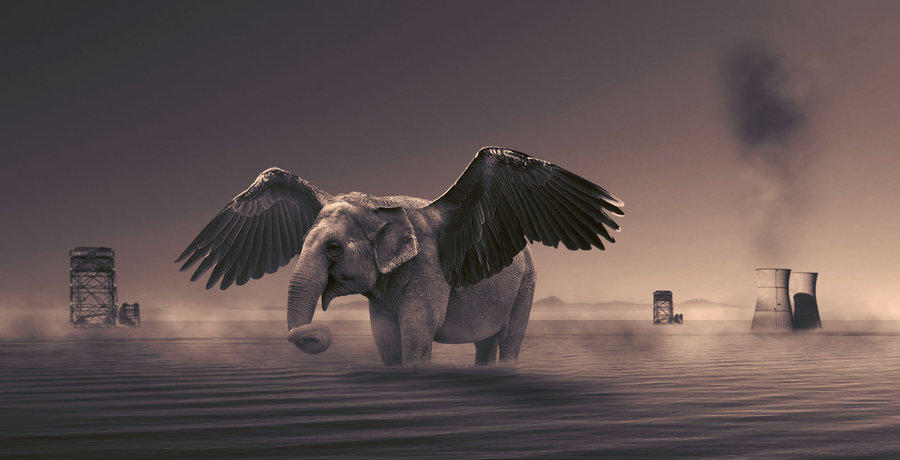
Artwork by Digital Gheko

Most people have heard the Indian tale about the blind men and the elephant. For those that have not, it goes something like this. A group of blind men come across an elephant and, perhaps puzzled by the noise it is making, set out one by one to investigate. The first one feels the elephant’s leg and rushes back to report to the others that it is some kind of pillar. The second one feels the beast’s tail and decides that the thing making the noises is some kind of rope. The third feels the trunk and decides that it must be some kind of tree. Another feels a flapping ear and thinks they must be dealing with a giant fan. The last one feels a tusk and concludes the bellowing noise is coming from some sort of pipe.

When the blind men get together again they cannot agree with one another at all about what they have encountered. Because each one of them had felt a different part of the elephant’s anatomy they all had a different subjective explanation for the phenomenon. Different traditions tell different versions of the story. In one, the king laughs at the blind men and tells them “You are all correct, and yet you are all wrong.” In another the blind men work this out for themselves and collaborate to build up a picture of the whole elephant based on the subjective experience of each one of them, thus obtaining an objective whole.

The story of the elephant works as a nice analogy for our understanding of the world. Each one of us is blind in so many ways and yet we all have to feel the elephant of reality. Our blindness is often educated into us, or sometimes it is because of a lack of experience. Some people see the world in terms of economics and finance. They are always talking about monetary policy and central banks and the value of currencies and commodities as if these things are the only aspects of any worth. Others see it primarily in terms of competition and threats. There are ‘good guys’ and ‘bad guys’ and allies and enemies. To their mind the world is just a stage for conflict, where the victorious and the defeated dance a tango until the end of time.

Then there are the religiously blind. These are the people who feel that everything can be explained through their own ‘one true faith’ and that the people of other faiths have got it all wrong. They say that God created the elephant in a magical flash.

For the greater part, most people can’t even be bothered to feel the elephant. "Roaring noise, what roaring noise?" they say. They are too busy listening to the snake charmer playing his flute, and they walk towards the sweet music, unaware of the cobra coiled in the basket.

And perhaps it’s dangerous to stand there for too long feeling the elephant. If one blind man were to run his hands all over the elephant’s body he might suddenly realise he was dealing with an immense beast that had the power to put a tusk through him like a toothpick going through an olive. And even if the beast didn’t do that and he ran back to his blind friends, who were all arguing about whether it was a fan or a pipe or a pillar, shouting “It’s a giant beast and it’s going to trample us!” they might all assume he had been at the shisha pipe too much and tell him to shut up.

The elephant analogy is often used to illustrate the concept of systems thinking. Thinking in systems gives us a wider perspective and allows us to see things more clearly, and to make predictions based upon this. If more people thought about the important systems that sustain them there’s a good chance that our problems as a species would be lessened. They might, for example, realise that pouring pollutants into the biosphere in ever greater amounts would inevitably lead to the biosphere being degraded and unable to support them. Instead, and given that we tend to be ruled by short-term economic thinking, we are told that the economy has a greater value than the biosphere, even though it is a tiny subset of the latter. An intelligent species would reorganise human economic affairs so that they complemented the natural processes of the Earth. Instead we get fracking, nuclear power and excessive fossil fuel burning.

But systems thinking has its limits too. Because humans are not robots we tend to be irrational in our actions and thought patterns. The conceit of many an intelligent systems thinker is that the boundaries of their mental model are wide enough to incorporate ‘enough of reality’ so as to make the stuff that lies outside of their model irrelevant. This can be a fatal error in a world of chaos theory because what you don't know or can't see can hurt you.

That's why the more intelligent branches of systems thinking recognise the limits of both knowledge and understanding. So, for example, someone practicing permaculture on a piece of land may have come up with what they consider to be the spiffiest design that incorporates natural cycles and organisms right down to the earth worms and the mychoorizal tendrils that transport nitrogen from plants' root nodules to nearby trees. If they are a good permaculturist they will know that their model is not infallible, that they can never know about the millions of different microscopic organisms that make up the soil and how they will interact with one another. They will do their best to create some system resilience by piling on organic matter, by not using industrial poisons, and by encouraging a diversity of life to flourish. But at the forefront of their mind will be the thought that they are merely the baton-waving conductor of a vast orchestra in which most of the musicians don’t even have eyes. They know the boundary of their perception and they hope things will work out. They observe and they make adjustments, but they can never play God. 

I was thinking about this recently in terms of renewable energy. Renewable energy, such as solar and wind, is abundant and free and relatively non-polluting. And yet, when you get down into the nitty gritty and feel the elephant, it looks a lot less feasible than its proponents claim. There are any number of grand claims that renewables can power an ever-expanding industrial civilisation in such a way that we don’t need to make any cutbacks in our usage. But, to me, these claims look highly dubious because they take little or no account of many of the major factors that make industrial civilisation - and therefore the production of these renewable energy systems - tick. Where would the investment capital come from to transform the world’s energy systems – which have taken over a hundred years to build and are eminently designed to burn fossil fuels and distribute the resultant energy from centralised generating plants? Where would the materials to do so come from? How will the political will to do such a thing be garnered in the face of such stiff opposition from powerful players? How would you convince the majority of people – most of whom either do not regard energy depletion or climate change as a problem - that the huge subsidies fossil fuels enjoy should be switched to renewables? There are plenty of parts to this elephant.

So, having felt the renewable energy elephant, the picture I get in my head is that barring some kind of miracle there will not be – cannot possibly be – a worldwide rollout of renewable energy to replace the fossil fuelled infrastructure in any time frame that could realistically be achieved. It’s simply not going to happen.

But then …

But then I consider that whatever opinion I might have reached on the matter doesn’t feature at all in the calculations and daydreams of those who claim that it is possible. And thus we get memes spreading around the internet like wild fire claiming things such as ‘Denmark produced 140% of its electricity from wind power in one day’ and ‘X square miles of solar panels in the Sahara could power the whole of Europe.’

So then I have to add in another factor to my mental elephant, namely that: even if I think, based on some pretty extensive feeling, that this beast is an elephant, everyone else is claiming that it’s a tiger. And what happens if something you think is an elephant is widely considered to be a long-nosed tiger? Will people be feeding it live chickens and admiring its imaginary stripes? Or will, on some metaphysical level, the elephant turn into a tiger?

Put more prosaically, will the fact that so many people believe a worldwide renewable energy grid could work – despite physical reality seeming to say otherwise – actually lead to its creation? Or will it lead to some kind of half-realised dream or, worse, will we end up with a tusk through our chest? When I pointed out the absurdity of Denmark’s claim to a friend he responded curtly “Yes, but at least they are trying.” It has a certain logic to it: trying is better than not trying.

So maybe that’s what will happen. Perhaps if we try hard enough we’ll produce enough renewable energy infrastructure to take the some of the sharp edges off the soon-to-be precipitous decline of fossil fuels (precipitous because we are can't dig 'em up cheap enough for our growth-wired economies to function). Perhaps at that point people will realise that renewables are great for some things and lousy for others but that we don’t really have a choice any more because of the nature of entropy. What will happen then? No doubt some will still hold onto their dreams of limitless energy and flying cars and cities on Mars, but by that point they will be in the minority. Perhaps then – and not until then – our shared predicament will mean we can start to agree on a consensual version of reality once again.

***

For anyone interested in reading my book The Path to Odin’s Lake I’m offering a one-off voucher meaning you can download an e-book version for free from Smashwords. Maddy Harland, the editor of Permaculture Magazine, recently published a review of it in which she wrote:

“In the final part of the book, Jason reaches Odin’s Lake, a place replete with symbolism and the energies of the ancient Norse gods. I won’t spoil the plot but suffice to say a journey’s end can often be hackneyed and obvious. Jason’s, however, is deft and he convincingly describes his apotheosis. This part of the book deserves re-reading as he is able to describe a rationale for living for those like me who are often burdened by the endgame of our civilisation’s unravelling. It is a permacultural form of curious medicine.”

Just click on this link to Smashwords and enter the code EZ94W. This coupon will expire in one month.


Thursday, December 19, 2013

Stabbing the Beast


I spent a while last night reading David Holmgren’s latest essay Crash on Demand (read the PDF here). Back in 2007 Holmgren, who is one of the initiators of the concept of Permaculture, wrote a series of possible future scenarios in which he posited a number of different scenarios that could play out with regard to civilisation and the environment. I won’t go into those scenarios here but suffice to say that this latest essay represents an additional one - and a new way of thinking.

The two civilisation destroying situations we face are peak oil and climate change. Holmgren goes into some detail about why his perception of these has changed, concluding that peak oil has not yet turned out to be as bad as expected (for various reasons, notably financial) and climate change is likely to now far exceed our worst expectations, with a 4-6C degree scenario now likely in a BAU scenario.

This change in thinking was the result of an observation of the way energy and economic issues are panning out, plus a deeper consideration of the role of finance courtesy of systems thinker Nicole Foss. The gist of it is this: we are rapidly losing the chance to persuade policy makers to take the risk of global warming seriously, and given that the course we are now on would likely wipe out nearly all of humanity and make life considerably worse for millions of other species over the coming millennia, then the only sensible option for us is to crash the system of global growth-based capitalism.

If that sounds radical that’s because it is. Holmgren points out that the last few decades of environmental protest have failed miserably. The dominant paradigm of ‘economic growth at any cost’ grinds ecocentrist concerns into the dust. A quick survey of the news headlines should convince anyone of the veracity of this. And although we are now living in an age of limits, where the quantity and quality of the fossil energy sources available to us begins to diminish, the system is perpetuated by the financial system which continues to magic credit out of thin air without any basis on a claim in the real world. Witness the shale oil boom in the US, a vastly inefficient and polluting operation that only makes economic sense due to the distorting wizardry of Wall Street financiers.

Furthermore, he rightly observes that the vast majority of people in the industrialised world could not care less about destroying the basis for life on planet Earth. As the global economic bubble deflates - something it has been doing since 2008 - most people in our overdeveloped economies are too busy trying to hold down a job or are too influenced by the growth-perpetuating mantra of politicians and the media to give much thought to the wider world. This is unfortunate, but at least it demonstrates the pointlessness of trying to gain political traction in a system that is rigged against anything other than limitless growth. Any concessions the system makes to preserving the biosphere tend to be largely symbolic, such as increasing bottle recycling rates, or charging a levy on plastic bags, while the real business of exploitation on a planetary scale continues apace.

Furthermore, the plateauing of oil production has not seen the rapid uptake of clean-tech that its proponents suggested would happen as soon as oil prices climbed. Instead it has seen a switch to dirtier and more dangerous to extract fuels, aided and abetted by the fossil fuel sector and its financial backers. So instead of moving into a ‘green tech’ future we are in practice moving into a ‘brown tech’ one. And although the financial instruments used to boost the production of shale oil and gas are by nature Ponzi schemes and cannot last, Holmgren argues that they may indeed last long enough to make a controlled powerdown situation impossible, as well as missing the window to wean ourselves off fossil fuels.

However, given that the economic system is only being held together by an almost-hallucinatory perception of continued growth and stability which is held by the majority, perhaps this is also the key to seeing its Achilles heel. Holmgren says that a sudden whole scale implosion of the global financial system is really the only hope of curtailing our carbon emissions and cutting them to a level that would avoid runaway global warming. He estimates the chances of a global economic collapse happening ‘naturally’ at 50% over the next five years.

But then he goes on to advocate giving it a good shove in that direction.

An estimated billion people on the planet live middle class lifestyles and use up the lion’s share of energy and resources. Holmgren says that if a section - he reckons 10% - opt out of the growth at any cost paradigm and massively downscale their involvement with the global system of capitalism, then this might be enough to send it into a terminal decline faster than it is already in. This might be easier than it sounds, he says. A majority of people are now disillusioned to some extent with bankers and politicians, and this number can only grow as promises continue to be broken and the wealth gap continues to widen. Actions could be as simple as withdrawing all your money from the bank and storing it as cash - after all, take £100 out of the bank and you are starving the system of £1000 of credit that it would otherwise use as part of the fractional reserve system. He goes on to advocate turning ones back on corporations, shopping locally, growing your own veg and all of the other things that Permaculturists and Transitioners do as a matter of course. This, he insists, is a positive thing to do that offers the only real hope of making a difference.

Adopting local currencies, bartering, avoiding paying tax and using the copious quantities of materials lying around as leftovers from the current waste-based economy would be ways of hastening the demise of the planet-destroying system, while simultaneously acting as a good model for late adopters, many of whom would want to ‘join up’ as the current system of industrial production begins to falter. This, he concedes, would also hasten the demise of a good many worthy and progressive projects, and would likely make enemies with those on the left of the political spectrum who rely just as much on the growth of the industrial system as those on the right. Nevertheless, he says, this is a bitter price that must be paid.

Would this be enough to starve the beast? Nobody knows, but it might represent a better expenditure of energy rather than waving a banner outside a climate conference. The system, he maintains, cannot be reformed. Instead it must die and be reborn. He is quite aware that advocating such a view would vilify him and others who could be accused of trying to collapse the economic system, but maintains that we have a duty to protect life on earth by any means necessary from a rapacious class of human being and a system that has got out of control. This is best done by building an alternative parallel economy - one that is not predicated on endless growth.

By a strange coincidence, after I had finished reading David Holmgren’s essay an email popped up in my browser. It was just telling me that Collette O’Neill - the Irish blogger who lives at Bealtaine Cottage - had a new post. I clicked on it and was greeted by a series of pictures and text that are a living example of everything David Holmgren was advocating. It summarised how she herself had turned away from ‘the machine’ and how this had allowed her to build her permaculture cottage and lead the kind of life that many dream could only be possible by, say, winning the lottery. See her example here.

http://www.futurescenarios.org

http://www.transitionnetwork.org

Monday, June 10, 2013

Up the Amazon on a Camel


Amazon rainforest cleared for soy production 

One unintended consequence of GMO and monoculture crops is the desertification of some of the most bio-intense regions on Earth. This guest post by Ray Neary explains more.

I don't normally do guest posts, but Ray and I go back a long way and went to school together and rode the rails around Europe as teenagers. These days Ray practices permaculture in the French Pyrenees and writes about GMO. See Monsanto Roundup Resistance for more info.


***

Camel riding isn't what you'd describe as a typical Amazonian tourist activity, but it might be a lot closer to becoming a reality than you imagine. We might not yet be surfing down the dunes of the Amazon basin, but the days of canoe trips up endless rivers through dense jungle are well and truly numbered. The only things that are endless in some parts of Brazil now are the soya plantations, and with three harvests a year they are very thirsty. Not only is the water disappearing as fast as the trees vanished, but the soil is too, now that there is nothing left to protect it.

On average for every kilo of food produced by the globalised food chain we have lost six kilos of soil. A kilo of cooked ham from a pig fed GM soya from Brazil has used 3,500 litres of water. Of course the majority of that production is bound for Europe and North America. Even though the majority of the charge falls on the food giants like Monsanto, Dow AgroSciences, ADM and Cargill, we also have a part of the responsibility for having allowed (and sponsored with our taxes) the globalisation of the food chain; we also have the responsibility to change things.

So while the world will be celebrating the feast of football that the World Cup in Brazil promises, we have to face the reality that if we continue as we are one day soon the only green things left in Brazil will be the football pitches. In some parts of Brazil fetching water has become the principal time consuming activity, just like in certain better known desertified regions including East Africa. Now there is also a growing problem of migration towards the slums of Sao Paulo as subsistence farmers are forced off their land.

It's a phenomenon unknown to many, yet it threatens almost half of the world's remaining land, and most of the worlds farmland. We've already almost turned half the world to desert - the barren Middle East was once called the 'fertile crescent'. It's called desertification and is incontestably the prevailing sign that our modern farming techniques are far from sustainable. If left unchecked its effects are disastrous. In Brazil we are witnessing the desertification of an area the equivalent in size to the surface of France and Germany combined, and purely due to deforestation, slash and burn destructive agricultural techniques and excessive ploughing. Sometimes in Brazil it takes as little as five years to transform woodland into desert.

This is not just happening to Brazil, it's happening to all the forests and farmlands of the world, even places considered traditionally to have green fertile farmland such as France are showing alarming signs of desertification. It doesn't have to be that way. Studies show that we are capable of feeding the world for future generations organically, without cutting down any more trees and even letting some grow back. 
In some areas of Brazil the desertification is being fought by using low-cost and ancient techniques, including constructing swales for water retention, and planting trees.

By doing this we might hope to save some rainforest - but that's not all we'd achieve, in doing so we'd reduce pollution, create humus that fixes carbon, increase the world's forests' potential to balance our carbon emissions, create jobs, provide healthier food, save energy and reduce emissions, have cleaner water (or still actually have some water), really start fighting hunger, improve living conditions for billions of people, reduce developing countries' dependence on providing cheap labour and resources or being forced into debt - indeed, what is there not to like, unless you are a corporation?

There have been many successful projects where desertification has been reversed. These are grass roots projects that have not involved the global giants of agribusiness; from South America to Africa, and China to the Middle East successful projects have been shown to work. Sustainable and regenerative projects, using principles like permaculture, are working with and improving not only the fertility and therefore the local ecology and biodiversity, but also living standards and animal welfare. 


Producing food locally with less energy limits waste, ends the speculation on food prices and limits the indexation of food prices with commodities such as oil - all of which lead to the instability of world food prices and elevated insecurity for poor communities and the tensions that creates. This is a distinct reality and we could be re-greening deserts the world over instead of creating them.

We don't need GMOs, we don't need intensive mono crops, we don't need to deforest the planet to feed the world, we just need better management, or even simply less “management”. Individually we can start making a difference today by thinking about what we eat and its consequences, and by getting more informed about where your food is coming from. If possible grow your own food (and teach the kids to as well) either in your back garden or by joining or starting a local community garden or free food initiative like Incredible Edible. When you buy food get organic and local or Fair Trade for imported goods. Boycott GMO, non-sustainable farming products, prepared food and the globalised food chain - your lives and those of many others depend on it.

by Ray Neary for Roundup Resistance 

Monday, January 3, 2011

Our house as an ecosystem

Up until about two and a half years ago we lived in southern Spain. We bought an old farm house and tried to live sustainably. Unfortunately we were hit by the downturn and ended up taking paid work in Denmark. Who knows, we might return one day. Here's a chapter from a book I have written that deals with that period.

Greenpeace was founded when I was about an inch long and happily growing inside my mother's womb, blissfully unaware of the perils of the world I was yet to be born into. When I finally emerged in 1971, if I'd been paying attention I'd have noticed that the world was in turmoil. The Vietnam War was at it's height and just a few days before I popped out half a million Americans marched to demand its end. Around the same time a new group called Friends of the Earth was also arising out of a growing awareness that the species I had just been born into was wrecking the planet. Oil prices were sky high, by the standards of the day, and it wouldn't be long before shocks in its supply made people aware for the first time that the human world we had created ran on oil.

Many men had long hair and beards around this time but my father certainly didn't. Back then Britain still had a substantial manufacturing base and my father spent his working life building cars and trains. It's difficult to imagine anyone less like a hippie than my father, but nevertheless the energy conserving ethos of the age was instilled in him and I grew up in a household where we had central heating but it was rarely turned on. During the coldest months of winter we would wear woolly jumpers, and sometimes even gloves, and not being able to see your breath meant that it must be summer. And it wasn't just my father who was like that, his generation was the last one to remember the rationing of the war and the long decades of stagnation and deprivation that followed. Because of this collective memory, and in response to the oil shocks that hit the 1970s, a movement grew up that called itself the appropriate technology movement. Their aim was as simple and sensible as it was laudable: to stop focusing on quick but expensive technological fixes to the oil crisis and develop simple and more cost effective ways to ensure everyone had enough energy to meet their needs.

In intellectual and activist circles the movement was a big success. People rushed to sign up for courses in composting, insulation and animal husbandry. Others built their own wind turbines and solar heaters. The movement went mainstream and even Jimmy Carter, the president of the United States, installed solar panels on the White House. In Britain a sitcom, The Good Life, about a couple who turned their suburban London home into a smallholding and shocked the neighbours, was watched by millions of people every week. I grew up thinking it was normal for people to help birth lambs in their bathrooms.

But then something happened to put a stop to all this fun. The oil price spikes of the 1970s had been caused by supply problems in the Middle East, especially Iran, but by the end of the decade these problems were retreating in the rear view mirror. Margaret Thatcher came to power in Britain and had the incredible good political fortune to coincide her ascendency with the discovery of massive oil deposits in the North Sea. Across the Pond, her partner in crime Ronald Reagan opened up all the spindles on every oil platform he had influence over and the age of cheap oil was upon us. This new era was born on a gusher, and all of a sudden nobody was watching The Good Life, they turned over to watch Dallas instead. The antics of rich and greedy oil barons like J.R. Ewing were far more compelling than watching Richard Briers wrestle with the ethical dilemma of killing a chicken for dinner. The raison d'etre of the appropriate technology movement vanished in a puff of black oily smoke and its acolytes were chased from public view, their ideas banished to the collective Siberia of the mind.

To make matters worse, around my eighteenth birthday the economist Francis Fukuyama proclaimed 'the end of history', meaning that the industrial western model of a consumerist democracy had trumped all other forms of social and economic organisation. Triumphalist free marketeers blew their trumpets from Kuala Lumpur to Berlin heralding a future of endless consumerism and corporate dominance. Mankind had reached an evolutionary pinnacle and idealism had no further part to play, so the wisdom went. I was at a loss. Cheap and plentiful oil had killed the Zeitgeist I had been raised with.

Until now. I stood in front of my house and wondered what I could do with it. In ring binders on my desk I had printed out thousands of sheets of scanned pages from how-to manuals typed out crookedly on old typewriters in the days before citizens had been re-branded as consumers. These were the Dead Sea Scrolls of the appropriate tech movement, abandoned in haste and left lying all but forgotten in dusty corners of public libraries and old boxes stored in the attics of the formerly idealistic.

The basic thing to recognise, I read, was that our home and the land it was on was an ecosystem. And like any ecosystem it was defined by its energy flows and materials. The material bit was easy to figure out as you could see it: walls, doors, trees, soil, lazy cats and the numerous buzzing bees, to name but a few aspects. And material things, if you were clever about managing them, went around in cycles. That was the whole art of permaculture, a contraction of permanent and agriculture: the way to use natural systems to provide yourself with food, wood etc., without diminishing the system. If I wanted any advice on this we were lucky to have one the founders of the philosophy, Patrick Whitefield, as one of our neighbours. Orgiva is that kind of place.

No less of a challenge though was the concept of recognising and harnessing the ambient energy without having to rely on dirty fossil fuels. Although I hadn't been aware of it at the time, the same year we moved into our house, 2006, was also the year of peak oil, according to the International Energy Agency. Whole books have been written about peak oil, and many more will be, but in a nutshell it is the moment when half of the world's reachable fossil fuel reserves have been exploited. 2006 was this moment and henceforth it will be rising demand and diminishing supply, meaning that price rises of a steepness we have never seen before are inevitable.

The harsh glare of the Andaluz sun seemed a most obvious source of energy. I learned that the sun was most readily available for two types of energy; to produce electricity using solar photovoltaic (PV) panels, and to use its rays to heat water in a tank. It seemed crazy that the roads of Andalucia were thick with trucks carrying butane gas bottles - most of it originating in Algeria from where it is shipped to Spain - when the sun could heat up water easily and for no charge. I had no idea how much a solar water heater might cost, but guessed at a couple of hundred euros. I was wrong. The figure was several times that. I couldn’t see how, what I assumed to be a very basic system could cost so much.

Further research turned up some interesting DIY projects that would cost almost nothing. Old radiators, cleaned out and painted black, could be installed easily as could old decommissioned boilers placed on the roof and painted with some light absorbing paint. Indeed, David and Aspen had made a perfectly functional and stylish shower block with nothing but coils of regular black plastic irrigation tubes on the roof. The possibilities extended in every direction with a bit of imagination.

Turning to PV, the options were far more complex. Our cortijo already had a solar system installed, albeit a basic one. A single Franco era panel sat on the roof generating enough power for a couple of feeble light bulbs. The old man we had bought the house off couldn’t see why we should want any more than this. A family of tailless geckos had made their home in the inverter box on the wall and a single truck battery bubbled and hissed away in the corner of what was to be Sofia's nursery. Our house needed to be brought into the 21st century.

The problem was I had virtually no understanding of electricity. I knew it could electrocute you if you stuck your finger in a light bulb fitting and I knew it was comprised of electrons that whizzed around violently banging into other particles. I bought a book that explained PV and electricity to its readers as if it were a kindergarten story. Amps were analogous to packs of huskies pulling sledges and electrical resistance was something to do with sticky snow. It was at my level.

Fully clued up, so I thought, I went off to talk to a solar installer about huskies and sledges and everything else I had learned. The professional engineer from Germany seemed a little puzzled at first but soon saw I was in need of help. He noted down everything that we might want to run in the house, when we might want to use it (e.g. TV and computers at night, sewing machine and iron in the day) and went off to do some calculations. When I next saw him he told me exactly what PV system we needed and where we could get hold of it. It was less painful than I had previously imagined.

Just to be sure I asked another expert and was told something completely different. Another one still came up with a third choice substantially different to the other two. I attempted some of the calculations myself but soon gave up. The task was proving more frustrating than I had anticipated. Surely it couldn't be that difficult? I spent several weeks in this state and a kind of solar paralysis came over me. I didn’t like to talk about our 'electricity situation' because I knew that whoever I mentioned it to would tell me something contrary to the prevailing latest advice. My own calculations were equally as confusing. Scraps of paper littered the dining room table with things written on them like '9 * lghtblbs * 4.5 hrs (avg) + TV (200w?) + 1hr wshng mchn (gen bckup?) = (assmg 8hrs fll sun frm 4 pnls 110w each)…etc'. Worryingly, whenever I mentioned sacrifice to my wife she raised a concerned eyebrow and said things like “Remember we’ve got children,” or “Perhaps we should get a grid connection as, you know, backup.” I was adamant about the grid connection. Plans were afoot to bring the grid to our patch of hillside – which seemed ridiculous to me seeing as everyone was living perfectly fine without it.

And then I got a phone call from someone who said he could help me. I arranged a meeting down on the coast and two weeks later was the proud owner of a solar system put together by an enthusiast and imported from the four corners of the globe. The panels came from Japan, the batteries (monster ones weighing over a hundred kilos each) from Canada, the inverter (the box that sits on the wall and converts battery energy to useful electricity) from Switzerland and the other parts from the UK.

The six panels themselves were high powered ones that sat in two arrays of three on our roof and the inverter was a meaty 4,500 watts – enough to power all the mod cons found in a regular grid-connected house. For backup I bought a petrol powered generator for times when perhaps several consecutive cloudy days have depleted the batteries or we were running every single appliance continuously. In these instances the backup generator would switch on automatically when the inverter detected a low level of battery power without even a blip in the supply. The supply itself was pure sine wave, which meant there would be no annoying hum on audio and video equipment, as could happen with non-sine wave inverters.

The total cost of our ‘overkill’ system was around €12,000. This came out as average when compared with other estimates we had been given, which ranged from €4,000 (a complete DIY job) to €22,000 (a rip off). Given that we would have had to pay €8,000 for a connection to the grid this meant that we had spent an extra €4,000 – with the added bonus that all electricity would be free and we knew that we would be generating very low levels of CO2 (although not zero when one took into consideration the production of the materials and the long distance shipping).

Next on the list of considerations was internal heating. No heating existed apart from a large open fireplace and a blackened hearth in the kitchen. But before considering what type of heating to install I learned that the best way to think about things was to start by asking what kind of temperature would be acceptable and working backwards from that. This might have sounded like a simple question but it may well be the cause of numerous marriage break-ups. Michelle, being Scandinavian, liked to bask in indoor heat. To her anything below 25C was ‘chilly’. I, however, was naturally attenuated to cooler conditions and could wear a tee shirt in conditions that made Michelle turn blue. So, after some horse trading, we agreed that a temperature of between 18 and 20 degrees centigrade was ‘reasonable’ in winter.

How to achieve this target temperature? The first thing we had to consider was insulation. There are many types on the market, some being highly artificial, such as polystyrene, and some being more organic, such as wool and straw. The most important factor to consider with the insulation was the u value. This is simply the measure of the conductive properties of the material – a lower u value means less heat can escape (or get in during summer). Use can again be made of the sun by installing a large south-facing window and building an interior stone wall behind it and painting it with very dark paint. This is an ingenious and simple method for catching heat because the winter sun, being so low in the sky, only falls on your wall during the season, when it’s most needed. The solar rays are absorbed by the heavy stone in the day and the heat radiates out slowly throughout the night, heating the house in the process. During summer the sun is too high to hit the interior wall and you are spared being roasted inside your own home. A similar effect could be had by painting an exterior wall black during the winter and whitewashing it again during the summer.

For ourselves, however, we opted for a regular wood burning stove, primarily because much of the fuel could be sourced from our own land. The key thing here was that wood should be burned at a high intensity to get as much heat from it as possible – a smouldering log was a wasted log, it turned out.

When we had our basic systems sorted out it occurred to me that all we had done was bring the house up to a level of amenity that we had been conditioned to expect from our society. After all, other people had been living there for centuries without any of the infrastructure we had just gone to great effort and expense to install.

This gave me pause for thought about the meaning of technology. Mere mention of the word 'technology' to most people conjures up visions of the latest smart phone, or perhaps technicians working in a laboratory trying to find ingenious ways to fuse atoms. But when it comes down to it, it is the basic technology of everyday life – clean water that flows easily out of taps, interior lighting when it is dark, and a means of disposing of our sewage – that people have forgotten about. To me, that's what technology boiled down to, and it'll be the kind of technology that people will miss the most if it is no longer available.