Showing posts with label denmark. Show all posts

Thursday, September 10, 2015

The Long Road

Refugees walking northwards towards Sweden along a motorway in Denmark

For the last few days hundreds of Syrian refugees have been trudging northwards up Danish motorways trying to get to Sweden. Right now, in Europe, if you’re a refugee you want to be in either Germany or Sweden as these are the two countries that have the most lenient asylum policies. Basically put, they won’t write a number on your arm, stick you in a detention camp or clobber you with nightsticks.

Judging by images on the news it’s a surreal sight. Denmark is a land of orderly neatness and happy conformity where the ugly reality of the ‘outside world’ is kept at bay. This is no place for unsightly groups of refugees. Long term readers of 22 Billion Energy Slaves will remember that I used to live in Denmark where I worked as a journalist, and moved to the UK two and a half years ago. Before that I lived in Spain, and before Spain I lived in Denmark again. As an EU passport holder I can flit from country to country and call myself an ‘expat’, and nobody calls me an immigrant or a refugee or an alien. It’s my privilege – I’m one of the lucky ones.

But the refugees don’t have any such luck. They drew the short straw of being born in the wold's most unstable region, and now they want to get out of it, even if it means crossing the sea in a leaky dinghy and risking their lives. Most of them don't actually want to be in Denmark. If a bridge could be built that passed right over the country you can bet that it would be filled with Syrians trudging from Germany to Sweden. Basically, they are unwelcome in Denmark. Fetegan Altorek, a 26 year-old Syrian yesterday remarked “It’s obvious to see they [the Danes] don’t like us. They spit on us and fight us.”

Perhaps they had not seen the adverts put out by the Danish government in recent weeks telling them they they were not welcome in the World's Happiest Nation (TM).

Travellers at the airport receive a different welcome

But not all Danes are like that, of course, and some have been stopping to offer lifts to the bridge that separates Denmark from Sweden. However, this is regarded as ‘people-smuggling’ and carries the risk of a three-year prison sentence. Some do it anyway, reminding their forgetful compatriots that Danish citizens once helped Jews flee to Sweden during the Second World War. “At the time we were occupied by the Nazis, but this time we voted them into power,” quipped someone on social media, referring to the current government and the resurgence of the far-left nationalists the Danish People’s Party.

Apart from the lure of not being incarcerated or deported, why do so many Syrians want to get to Sweden? To live in peace and join family already there, they say. I had a chance to see some of them doing just that when I went on a walk to a Swedish forest last year. I wrote about it in my book The Path to Odin’s Lake, in a chapter I called The Far Flung People. This is an excerpt, in which I had just emerged from the forest into a small rural town in a bucolic setting, and had found a hotel in which to get some breakfast:


The girl on duty, presiding over an empty breakfast buffet, was accommodating if a little frosty, although in all probability I did look as if I had been dragged through a hedge backwards. Which was half true. I poured myself a coffee and sipped the sweet black liquid, savouring its restorative effect as I gazed out of a window at the empty streets. By the time I had finished my second refill and also eaten a Danish pastry (also called Vienna bread in Sweden) people in the outside world had begun to wake up and give some life to the town.
But something was odd. One might have expected the people walking the streets in a tiny town in rural Sweden to be, well, Swedish. But almost everyone I saw looked to be from the Middle East. Women wearing headscarves pushed prams, men sat on walls idly fingering worry beads and olive-skinned teenage girls giggled and chatted into their mobile phones. Among them was the occasional obviously Swedish person – an old silver-haired woman here, a blonde boy on a moped there – but the majority were clearly from somewhere else. They were all smart-casual dressed, as if they’d just stepped out of an H&M store. “What’s going on?”, I asked the girl behind the breakfast bar who, in other circumstances, could have been a catwalk model and perhaps was. “Are these people refugees?”
“Yes,” she replied sparsely. “There is a centre here.”
I asked where they had come from. “Mostly Syria, from the war”, she explained. “Some from Somalia.” I thought back to the man I had seen earlier at the lake, about how his eyes had been so wasted. I didn’t think Somalis liked to drink.
“There is nothing for them to do here”, said the girl. “They are not allowed to work, so they just hang around. Some have bad habits.”
I wondered if this was causing problems. Sweden, famously, is the most accommodating country in the world when it comes to taking in refugees. Its liberal policies dating back to the 1960s have been the envy of progressives the world over, and many of the Swedes I had met over the years were justifiably proud of them. But decisions about refugees were made in faraway Stockholm, and such an influx of people from a different country, with a different religion and culture, was bound to cause tension, I thought. The girl seemed to read my mind.
“Some people say there are too many for our town – we are only 800 people but we now have to support 400 refugees.”
“Is this a problem?” I asked.
But the girl just shrugged. “No problem, really”, she said. I tried to ask her more questions but she became tight-lipped, indicating that the matter was closed, so instead I asked her how much it cost to stay the night in the hotel.


Röstånga in the afternoon wasn’t much different from Röstånga in the morning. The lumber trucks still rolled southwards on the Riksväg 13, the occasional moped or Volvo stopped at the petrol station and the streets were still scattered with bored-looking refugees. They milled around listlessly in small groups; a bunch of pram-pushing women here, a row of men sitting on a wall there. Their presence in this rural Swedish hamlet was incongruous and they seemed like actors in a movie who had turned up on the wrong set. It was as if they were waiting for something to happen, a bus to arrive, or a concert to start.
During half a lifetime of travelling the world I had noticed that in most countries people’s lives are played out in public places. From Madrid to Istanbul, Guatemala City to Mumbai, it is on the streets that social interaction takes place, news is passed on, gossip is blathered, deals are done and emotions are vented. Not so in Scandinavia. The streets here are infrastructure – cold boulevards for the conveyance of people and goods from A to B. Scandinavian life takes place in private behind closed doors, and perhaps that’s why these people seemed out of place.
Passing a few women on the pavement I tried to make eye contact with them. Most blocked me out but one made the briefest of contact before looking quickly away, as if embarrassed. Another group, this time teenage girls, gave me the same response. The groups were always segregated by sex. It was a curious thing, this business of casual greeting. During my perambulations around the forest, I had often come across other walkers. In Britain, nine times out of ten, walkers crossing paths in a forest would greet each other with a cheery ‘morning’ or ‘afternoon’. In Denmark, I had found the opposite to be true, but here in Sweden it was really a 50/50 situation. On the one hand you could take the initiative and boldly say ‘hi’ only to be met with that steely Scandinavian look of horror that a stranger is trying to make contact with you, but on the other hand there was an equal chance that the other party would take the initiative just when you had decided it wasn’t worth making yourself look a fool. After a few days of this I had learned to settle for some brief eye contact, a quick head-nod and a short ‘hi’ at the ready on my lips should they greet me. It was best to hedge one’s bets.
But with the refugees it was a different matter. There was a barrier there; something protective was in place. I was interested in speaking to a few of them, curious to find out their stories. But it seemed that the newcomers inhabited a different world to the Swedes – a kind of parallel universe separated by a vacuum across which communication was difficult. Eventually, after wandering around the village in circles, I decided I had better find out what time the bus would come the next morning to take me back to Lund.
At the bus stop two men were talking animatedly in Arabic. They looked to be in their mid-twenties, one heavily muscular and with a crew cut, the other thin and bearded. I guessed they were friends. As I stood there studying the timetable the muscular one asked me if I had a light. He stood there with an unlit cigarette hanging from his lips and mimed striking a flint lighter with his thumb and clasped hand. I rummaged in my bag and found one, proffering it to him. He took it and lit his cigarette and then that of his friend, handing it back to me between hands pressed together as if in prayer. I asked them where they were from. “Syria”, he said.
“What do you think of it here?”, I asked, meaning Sweden.
“Good life”, he replied, inhaling the smoke. “Good people.”
It was a stupid question. I asked him another stupid question. “Why are you here?” He immediately said something to his friend, who it was clear did not understand English, and they both laughed. “Assad”, he said. He thought for a moment and added “War bring us here. When Assad gone, I go back, rebuild my house”. He turned back to his friend and they continued with their fast-paced conversation and I, having noted the time of the buses, left them to it.


Granted, it wasn’t much of an insight, but the thing that struck me the most was how deeply separated the hosts were from their refugee guests. And with the refugees being unable to work or better themselves, isn’t there a risk of them going stir crazy? Scandinavians love to talk of ‘integration’, but that would seem to be quite a tall order when such a barrier exists. In any case, I suspected, integration really means ‘forget who you are, be like us’.

Yet at the moment, despite all the media hysteria, it is just a trickle of refugees arriving. It’s a given that there will be more. Currently, like everything these days, their appearance is highly politicised. You’re either for them or against them. Currently, if one is a right-wing ‘realist’ you will talk about building walls and fences and dropping more bombs on the countries they are fleeing. Bombing is always offered as a solution to violence. On the other hand, if you’re a compassionate liberal you talk about opening up the borders, giving them all somewhere to live and allowing them to invite the remainder of their families over too. I suspect that this second point of view will sadly have a limited shelf life as things progress further down the road and people begin to grasp the sheer scale of the problem. 

And the rhetoric on both sides is rising, which is unfortunate if not entirely unpredictable. The unpalatable truth is that the Middle East and North Africa is becoming uninhabitable and not fit for human habitation. 100 years of oil exploitation, imperial plundering and ecological mismanagement has led us to here. In the case of Syria, as this article in The Ecologist points out, disastrous land management practices initiated in the 1960s turned most of the Syrian steppe into a dustbowl. Global weirding, in the form of droughts, followed by downpours and epic dust storms, destroyed much of the remaining topsoil. Millions of farmers and pastoralists were disenfranchised – ideal recruitment fodder for jihadist militias.

So a proxy war between Russia and the USA over control of the remaining energy resources was all that was needed to tip Syria into total chaos. The population is caught between their own crazy dictator dropping barrel bombs on them, and the murderous thugs of ISIS cutting and raping their way across what’s left of their country. Is it any wonder they want to get to Sweden?

The wider picture is no less unappealing. The age of oil that allowed for the greening of the desert is drawing to a close. Nitrogen fertiliser was first synthesised using fossil fuels after the last world war, meaning that vast swathes of desert could now be irrigated and used for growing crops. At the same time, selling their oil wealth has permitted countries such as Saudi Arabia to import massive amounts of food from the more fertile areas of the world, and to create a generous social security system for its people. Predictably, in light of this, the birth rate shot up, meaning there are now an order of magnitude more people living in these fragile desert regions than the ecology can support. As the oil crutch is kicked out we’ll find out the hard way that you can’t bargain with nature.  So it goes.

And so pretty soon we can expect hundreds of thousands more from Syria. Turkey currently puts up two million of them, but as other nations prevaricate and squabble, its patience is wearing thin. There are said to be twelve million Syrians displaced. And after Syria we have Afghanistan, Libya, Egypt, Yemen, Iraq and a few other places that we have meddled with. That’s not a political statement, it’s a simple fact. Where else will they go other than the smallish, wealthy and fertile western Eurasian appendage knows as Europe? There are 381 million people living in the arid regions fringing Europe, and it has the fastest-growing population of any of the planet’s major regions.

Last year I had a conversation with an historian who knows a thing or two about mass migrations. “It starts off as a trickle,” he said “but then, as things collapse, all of a sudden it turns into a flood. When you have entire nations full of people suddenly deciding to get up and leave, there is literally nothing anyone can do about it.”

“What about Europe?” I asked.

“Italy, Spain, Greece, France, a few other places … toast,” was his reply.

That’s the predicament we’re in. It won’t be pretty and our only guidance is compassion, not fear. The great change is already upon us.


Wednesday, January 30, 2013

Denmark goes Nuclear


Okay, so it's something that has been bothering me for some time. In response to my last post some readers, on various sites, have said things along the lines of 'Denmark is a great place to be because everyone pulls together and is environmentally-minded, and it would be a big mistake to leave and go back to decrepit Britain.'

Well, bull and red flag. That got my brain boiling and I have three things to say on the subject of Denmark before I never mention the subject again. EVER!

If you're only interested in what's mentioned in the title of this post, skip straight to point three and ignore the rest.

Some explanation is needed.

One. Denmark does not 'pull together'. The people of Denmark do as they are told to do, think what they are told to think, and never question authority. Minds are controlled by state propaganda, and the janteloven, which I mentioned in the previous post, keeps people servile and compliant. One cannot expect any help if something bad happens to you, as I was reminded a couple of months ago when an American student was attacked on a bus here in broad daylight and beaten up for being a 'Chinese boy' while every single passenger turned a blind eye.

This is not an uncommon occurrence. I myself had a bike accident once and lay bleeding on the road for several hours, unconscious. When I came to, people were sat at the nearby bus stop listening to their iPods as if I didn't exist. Nobody offered to help me, even though I had a huge gash on my head and was liberally covered in blood. Thanks for the help guys.

A close-knit community. Did I mention that after five years of living in this block of flats I've only spoken to one neighbour out of eight? I mean, I've said 'Hello' and got either a grunt in return, or more likely, some passive-aggressive silence. I'm not counting the old woman next door, who rang the doorbell to call me something horrible based on my non-Danishness. Or the person who reported me for 'introducing a bio hazard' with my worm compost bin, leading to me having to get rid of it and euthanize my beloved team of red-wrigglers.

Two. Denmark is not the best country in the world, as if there could ever be such a thing. Almost every week there is a report saying so in the media. Danes believe their flag is descended from Heaven and that they are the chosen ones. The country supposedly has the best restaurant and food, the happiest people, the smartest society, the most environmentally friendly civilization on the face of the planet, the best city in the world to live in. I could go on.

They have been talking about this for a long time, as the narrator of this video clearly states:


The reality is that a majority of people in the world have never heard of this pipsqueak country. Please, Danes, stop it. You are embarrassing yourselves and will only regret it later!

(Is it impolite to mention also that it's also the cancer capital of the world, has a huge problem with alcoholism and suicide, is Europe's second most wasteful nation and is addicted to coal and has the fourth largest environmental footprint of any country in the world?) Is it a case of 'we think OSDS'?

Three. Relating to two. This week - and I just have to share this with someone because nobody really in the international press outside of specialist international policy websites has reported it - Denmark flunked out of pretending to be green! Yes, you read it here first. Extra, extra! Greenland, which ahem, is kind of independent and allowed to do what it wants as long as Copenhagen agrees to it, is being sold to the Chinese! Well, not all of it, just the bits that contain uranium. This, apparently, would make supposedly anti-nuclear Denmark one of the biggest exporters of uranium on the planet.

They don't want it in their back yard - they want it in yours!

But it's not just uranium. Eco-friendly Denmark wants a slice of the oil pie too. Denmark's version of the-historical-German-party-whose-name-cannot-be-mentioned-in-polite-company- said that 'Future generations will not forgive us,' if Denmark does not go for the massive oil and uranium grab on turf that it controls. And the main parties all seemed to agree.

Greenland's deputy prime minister, the eminent statesman Jens Frederiksen, gave the matter some deep thought and after a profound philosophical enquiry stated: "If everybody else can sell uranium, then we might as well. There's a lot of money in it."

Kerching!

Denmark's avowed social-liberal prime minister Helle Thorning-Schmidt, who is known more for her Gucci handbags than her policies, has become tight-lipped and is refusing to answer any parliamentary questions that contain the word 'Greenland'. Apparently she says it is 'not appropriate' to talk about Greenland's 'private affairs'.

This is Denmark's prime minister showing off her hoard of designer swag. No, honestly - I'm not joking.


So there you have it. When Denmark put out all those press releases about it being the greenest, most sustainable country on God's fair earth - it didn't really mean it. Apparently it's okay to tell big fat pork pies if that's what everyone else is doing. Especially if it keeps the money taps open and the investment cash rolling in. You can't expect having one of the highest standards of living in the world to just pay for itself, you know.

Now where was that writer from who wrote the story 'The emperor's new clothes'?

This particular blogger is tired of stating the bleeding obvious and will welcome spending his time doing something more positive than thinking about these matters from now on. 'Nuff said.

***

By the way, a big thanks to everyone who is continuing to read this discursive, peculiar, iconoclastic, mildly subversive blog of mine. This month, for the first time, I've hit the 10,000 page view mark - and it's going up by 10% a month - which is leading me to think that I might actually put some more effort into writing these posts.

As it is, I hammer them out whenever I have a spare moment at the kitchen table. Over the next couple of months I'll be 'in transit' back to England, so will be posting a bit infrequently, but when I get settled I'm planning to start writing in a more structured way.

That's what you can do when a full-time job isn't getting in the way.

Monday, January 21, 2013

Staring at the Sea


I announced recently on the pages of this blog that I would shortly be leaving Denmark with my family and moving back to the UK, where I am from. This decision was a long time in the making and the past couple of years of agonizing could be neatly summarized by The Clash song ‘Should I stay or should I go?

In the end, of course, we chose to go back to England, where at least one of us is from (my wife is from Denmark and our two young daughters were born here). Without wishing to be too reductionist about this decision, I took into consideration all the factors that I think will be defining in an era of depleting net energy and social unrest that I think we are now entering into. When all was said and done, however, I had to go with my heart and what common sense told me. It’s long been a hunch of mine that one of the most important things about positioning yourself in preparation for the great Stopping of the Music is to make sure you will be somewhere where your face fits in and the people who surround you share the same cultural values. So, no moving to Outer Mongolia or darkest Peru for this WASP. 

Perhaps the most agonizing aspect of this decision was the fact that land and farmhouses in Denmark are dirt cheap compared with Britain. I had fallen in love with the island of Møn, an idyllic island in the south of Denmark, covered in ancient Neolithic tombs, and populated by small villages filled with the kind of chocolate box thatched cottages you see on postcards. Here one could buy a 200 year old farmhouse in excellent condition with six or seven bedrooms plus outhouses, a couple of acres of land and probably an orchard or two along with some woodland and still have change from £150,000 (or $235,000). The same property in the UK, where the bubble is still rampant, would set you back up to a million pounds – around six or seven times the price in Denmark.

But, tempting as this was, when we really considered all the factors, the UK seemed like the better option FOR US.

So, without further ado, these were the factors that were taken into consideration in deciding which side of the North Sea to live on. It goes without saying that these are not the ONLY factors – but these were the ones that stuck out in my mind the most.

1 – Energy. When it comes to comparing the UK and Denmark, neither comes out very well in terms of future energy supplies. Both largely rely on oil and gas from fields in the North Sea which have double digit annual depletion rates. Neither country has much of a manufacturing sector (and what remains of Denmark’s is becoming increasingly uncompetitive due to high labour and energy costs) with high energy requirements, so most energy is used for transportation, heating, agriculture and leisure. 

Denmark’s energy policy, at least officially, is geared towards a high-tech ‘green’ future of wind turbines (of which there are already many) and solar panels to power a smart grid and a transportation system based on electrical energy stored in batteries. The country at present meets most of its energy requirements from burning coal, natural gas and post-consumer waste, with some imported power from Sweden, which produces nuclear power. Denmark has no nuclear power itself, although Sweden’s Barseback nuclear reactors are sited just across the Øresund Strait, easily visible from where I live. [Both reactors have now been decommissioned but still contain nuclear waste, and plans are afoot to make the site a short term nuclear waste storage facility as Sweden winds down its nuclear power programme.] Around a quarter of electricity currently comes from wind power, and the plan is to increase this to 50% by 2020. Denmark may be able to achieve this by trading power with Norway, which has the topography to allow for storage in the form of hydro power. Whether it does or not is a different matter. The country is aiming for 100% renewable power by 2050.

The UK doesn’t really have a coherent energy policy. Sweeping pronouncements are periodically made by ministers but these usually run into problems before anything is implemented. With the windfall from oil and natural gas now winding down serious problems are now on the horizon and rolling blackouts are likely by 2015/16, according to no less an authority than the UK energy regulator Ofgem. The country has several ageing nuclear reactors and there is a strong nuclear lobby that favours building more, despite robust public opposition. 

Renewable energy, which is bountiful in the form of wind and wave power, was growing well due to a favourable investment climate and a generous FIT for home owners, but has stumbled of late due to widespread ideological opposition by the right-wing press, and cuts due to the implementation of austerity measures. Furthermore, politicians have jumped on the hydro-fracturing bandwagon, with breathless announcements of trillions of cubic feet of natural gas in the rock formations beneath Britain, which has further pulled out the rug from beneath the feet of the renewable industry. The fact that this fracked gas has a very low net energy level and lies beneath privately owned and heavily populated land (unlike in the US, the UK government does not have the right to extract minerals from beneath privately owned land) does not seem to deter the enthusiasm of the fracking advocates.

Given that nuclear plants won’t be ready in time and are probably unaffordable, oil and gas is running out, the renewable energy industry is being strangled by ideologues and fracking is a mirage, it does seem likely that the lights will indeed be going out in Britain sooner rather than later. There is some coal left in the ground, although much of the capital for its extraction was laid to waste during the Thatcher years, so the best that Britain can hope for is favourable terms with Russia, as it imports natural gas at the end of a very, very long pipeline.

 2 – Transportation. Neither the UK nor Denmark are particularly large countries (and the UK is set to get a whole lot smaller if Scotland opts for independence, as seems likely), with land masses of 94,060 and 16,562 square miles respectively. Both have excellent transport links, with numerous roads, functioning rail lines and sea ports. Denmark, famously, has an excellent infrastructure for cycling owing to policy decisions made after the 1970s’ oil shocks, and its relatively flat topography. At the city level around half of all trips are made on two wheels. 

The UK is considerably less cycle friendly as the powerful motoring lobby has very effectively made sure that money is funnelled into road projects suited to cars rather than bicycles, and local councils have haphazardly implemented cycling infrastructure that in most cases doesn’t connect.

Nevertheless, Britain is criss-crossed with canals from its manufacturing days, and there is no reason why these shouldn’t go into full time use again. Furthermore the tow paths alongside these canals in many cases already double as cycle lanes. There is a national bicycle network, and things can only improve for low speed forms of transport as the number of journeys made by car continues to diminish, as it has been doing for some time now. 

3 – Food security. Neither Denmark nor the UK has much in the way of food security. At present both countries rely on very long supply chains and just-in-time delivery systems to get food into shops. If both countries had to rely solely on what was available to them from their own soils and seas then mass starvation would quickly ensue. The last time Britain was tested in this respect was during the Second World War, when a mass mobilisation of the population to grow food just about managed to feed the nation (although many were away fighting in other countries). Then, there were around 30 million residents, whereas today there are over 63 million (Denmark has about a tenth of that number). Furthermore, it must be assumed that 70 years of mechanised farming has considerably reduced the capacity of the soils to grow food, and relentless overfishing has reduced fish stocks drastically as well. In terms of wild game, there is not much that would survive more than a few short years if the population was in a state of extreme hunger and short term crisis management.

The one bright spot in this otherwise dismal picture is the rise of organic farming and local food networks. These have grown enormously in recent years as people put less trust in the corporately-controlled food web and opt instead to eat more local and more healthily. 

Denmark, similarly, has a food problem. Despite a much lower population, the relatively fertile soils cannot yield the heavily meat-based diet to which Danes have become used to. Technically, we are told, Denmark is a net food exporter, but in my local supermarket the only things I can find that are grown here are potatoes and apples, so I’m guessing that there is some statistical figure fiddling going on there. 

Farming in Denmark is in something of a crisis at present due to many farmers taking out large Swiss franc denominated loans on government advice with which to buy new machinery and other capital. Servicing these loans has now become unaffordable for many as the Swiss franc has appreciated due to its supposed safe haven status. Furthermore, food production is geared towards the production of 25 million intensively reared pigs a year and cash crops, especially rape seed, although much is also given over to wheat production. Local food coops do exist, but they are relatively few compared with the UK. Nevertheless, consumers do tend to opt for organic food, with even the cheap supermarkets stocking a good range of food grown without chemicals (although often it is imported).

3 – Governance and society. There are clear differences between the UK and Denmark when it comes to governance. For historical and cultural reasons Denmark is governed well and the UK is governed not quite so well. Both are democratic societies hung on the framework of a monarchy, with the royals enjoying almost universal adoration in Denmark, as opposed to ‘only’ 82% in the UK. Both countries have coalition governments, although only Denmark has radical factions representing parties founded on both Marxism and ultra-nationalism enjoying any power.  

Denmark is characterised by its homogenous native population and has sometimes been described as ‘more of a tribe than a nation’. There are few social strata within Denmark’s famously classless society (although I would question this assumption) and politicians must appease the entire nation, rather than one particular power group within it, and are held accountable as such. The social contract in Denmark is very strong and rigid and has been aptly described by the half-Norwegian novelist Aksel Sandemose as the ‘Jantelov’ – a set of unwritten codes of conservative behaviour by which Danish people unwittingly live out their lives. The codas are effectively anti-individualistic in nature, requiring that the common man or woman suppress their own personal desires and ego for the common good of the state. 

The other side of the bargain is that rulers (political and monarchical) must be trusted to ensure the stability and survival of the state. Any digression from this bond of trust is treated with public opprobrium. As a result, Denmark has a very progressive tax system and it is said that ‘nobody is poor and nobody is rich’. This might be a bit of an exaggeration, but the fact remains that allowing everyone to enjoy a comfortable middle class lifestyle, while enviable to liberals from less progressive countries, nevertheless rests on the assumption that there will be a continued abundance of cheap fossil fuels and favourable trade deals with poorer nations. In other words, it can’t last.

The UK, by contrast, has something of a class war going on. Although the old system of inherited caste privilege is dying out, a new breed of ultra-wealthy people sit at the top of the ladder and use the resources of the poor to further advance their wealth advantage, and in doing so hollow out the core of society and make it more prone to social upheavals. At the centre of this black hole is the hyper-power known as the City of London (not to be confused with the actual physical city of London), a vast Ponzi scheme that holds a large amount of power over the government. The City, which enjoys very little regulation, is said to be ‘too big to fail’ although its activities have caused the UK economy to be hugely unbalanced in favour of unproductive financial derivatives at the expense of the ‘real’ economy of goods and useful services. Unfortunately, when it does inevitably fail, the likely results will be catastrophic, which brings me onto the subject of …

4 – Finance and economics. Denmark and the UK are similar in that they both hold ‘world records’ in the debt stakes. Denmark has the unenviable position as the country with the highest household debt. At something like 400% of annual income – and growing at an alarming rate – Denmark’s consumers have been spending money over the past few years like drunken sailors who just washed up on the mythical shores of Consumerlandia  and found the streets to be paved with gold VISA cards. 

Maybe it is the widely-held belief that nothing bad can happen to them and that the government will ride to rescue that has caused all of this, but it is was certainly also the case that this cheap credit was pushed onto those least able to afford to pay it back as well. As ever, it takes two to tango. Cultural factors may also play a part. Danish people like to think of themselves as ‘virtuous’ and ‘deserving’ and the Lutheran religious values of purity which are buried like undead zombies under the floorboards of the nation’s psyche, have crawled up to manifest themselves as people who live in flats where everything is painted white and decked out with expensive designer furniture. A weekend in New York to pretend to be one of the characters from Sex and the City, or a quick holiday to Thailand in the deep of winter to top up your tan is considered normal behaviour in this virtuous zombie culture. Is it any wonder that Denmark is routinely quoted as ‘the happiest country on Earth’?

Many people took out 100% mortgages in the last decade, and opted to pay only the interest rather than any of the capital. Now, with several small and medium sized banks having already crashed, lenders are forcing borrowers to pay back some of the capital – and many of them are suddenly finding they cannot afford it. A popular prime-time TV programme in Denmark is Luksusfælden – or ‘fall from luxury’ – in which insolvent families are visited by some hard-nosed financial advisors and put on a tough economic diet, which sometimes they cannot stomach.  Notable episodes have included a woman who thought that denying her children designer clothes was tantamount to abuse and broke down in tears when confronted with some perfectly good second hand clothes, which was all she could afford.

Denmark may well be a nation of superlatives. Not only does it have the world’s highest household debt, but it also has one of the world’s largest public sector (for a ‘free’ nation, continually vying with Sweden for first place) and the world’s highest tax rate. It is calculated that the marginal tax rate is as high as 70% - meaning that by the time you have earned and spent your wages, some 70% of it has gone back into the public coffers in the form of income tax, VAT and various other taxes and charges. Not that Danes seem to mind – on the contrary, opinion polls repeatedly show that given the choice between lower taxes with fewer public services and higher taxes with a greater safety net, people will always opt for the latter. It drives foreigners living here nuts, especially the Americans.

The UK, similarly, is a nation of debt junkies. Although personal debt is nothing like as high as Denmark’s, the national debt is stratospheric. The country as a whole owes about a trillion pounds, split between government debt, financial debt, private debt and business debt. The government debt is growing at a rate that makes it impossible to ever repay, no matter how much ‘austerity’ the government imposes on the bankrupt populace. This is, of course, the same situation that every European nation finds itself in after three decades of monetary expansion based on cheap credit and fairy money, but more so. With diminishing tax revenues from North Sea oil, a growing budget deficit, an elderly and retiring work force and huge financial and property bubbles there is simply no way that the UK can avoid going spectacularly bust. When it happens it won’t be pleasant.

5 – Climate change. This is already having an impact on the UK, where it has been raining heavily for half a decade now. Gone are the dreams of many who, some years back, forecast that we would have a climate similar to the south of France and that most of England would be good for growing grapes. Instead, we have a cold wet slap in the face, persistent flooding, and wild swings in temperature. Of course, this could change again as ocean currents shift, and the country (and northern Europe as a whole) will rapidly turn into an ice block if the Gulf Stream shifts to the south or peters out entirely. In this respect Denmark and the UK are in the same boat.

In terms of rising sea levels, the UK has a clear advantage over low-lying Denmark, whose highest point is Himmelbjerget (‘Sky Mountain’) which rises to a majestic 147m (482 feet). Indeed, sea levels will not need to rise by more than a few metres for much of Denmark to simply disappear into a kind of Atlantis with stylish furniture. An added worry is that as polar ice melts in the Arctic this could trigger tsunami-producing earthquakes in a process known as isostatic rebound, which would have the potential to sweep over Denmark with devastating consequences. You think it couldn’t happen? 

The UK at least has topography on its side, although certain areas such as East Anglia and the Thames Valley (where London is situated) will cease to be land. Having the resources and money to build huge defensive walls against sea rise in the future seem about as unlikely as the assumption we will be able to build floating cities or, indeed, live on the bottom of the sea like crabs.

6 – Housing. It seems odd to mention housing as a key consideration in deciding which country to live in, although in this case Denmark emerges as the clear winner. Due to the aforementioned good governance, housing in Denmark is generally of a high standard. Insulation is at standards that Britons can only dream about, which is just as well as it gets mighty cold in Denmark (it is minus 15 degrees centigrade outside right now as I type this in my super-insulated flat).

Britain, by contrast, seemed to give up building proper houses after the last war. Cheap and cheerful became the driving ideology and ever since we have constructed millions of cheaply-built identikit houses, created suburban sprawl and blighted the landscape. What’s more, these cheaply constructed houses are almost unaffordable to the average person who wants to avoid wage slavery. In fact, if one wants to buy a house in the UK that will keep you warm, won’t break the bank and won’t have bits flying off it in a gale you have to look at properties that were built over a hundred years ago. Many of these, however, have preservation orders put on them, meaning that owners are not permitted to make improvements on aesthetic grounds.

7 – Trade Links. Internal trade links are likely to prove robust in both countries due to the aforementioned good quality transportation networks. Trade with other countries, when things settle down, is likely to be with regional partners. I expect the UK (or whatever the country is called in the future) to have good trade links with France and other places in Europe, as it had in the past.

Denmark, as with many other factors, is likely to look more and more to Norway and Sweden for trade and protection. With their shared cultural and linguistic heritage, I envisage Scandinavia’s northern countries being some of the ‘better’ places to live – at least if you are a Scandinavian or can pretend to be one. I can imagine energy and fuel (in the form of wood and hydro power) being exported to Denmark from Norway, which has plenty of space and resources, perhaps in exchange for grain and other agricultural products. Denmark itself has little in the way of exploitable natural resources so it’ll be back to the land for the majority of the populace.

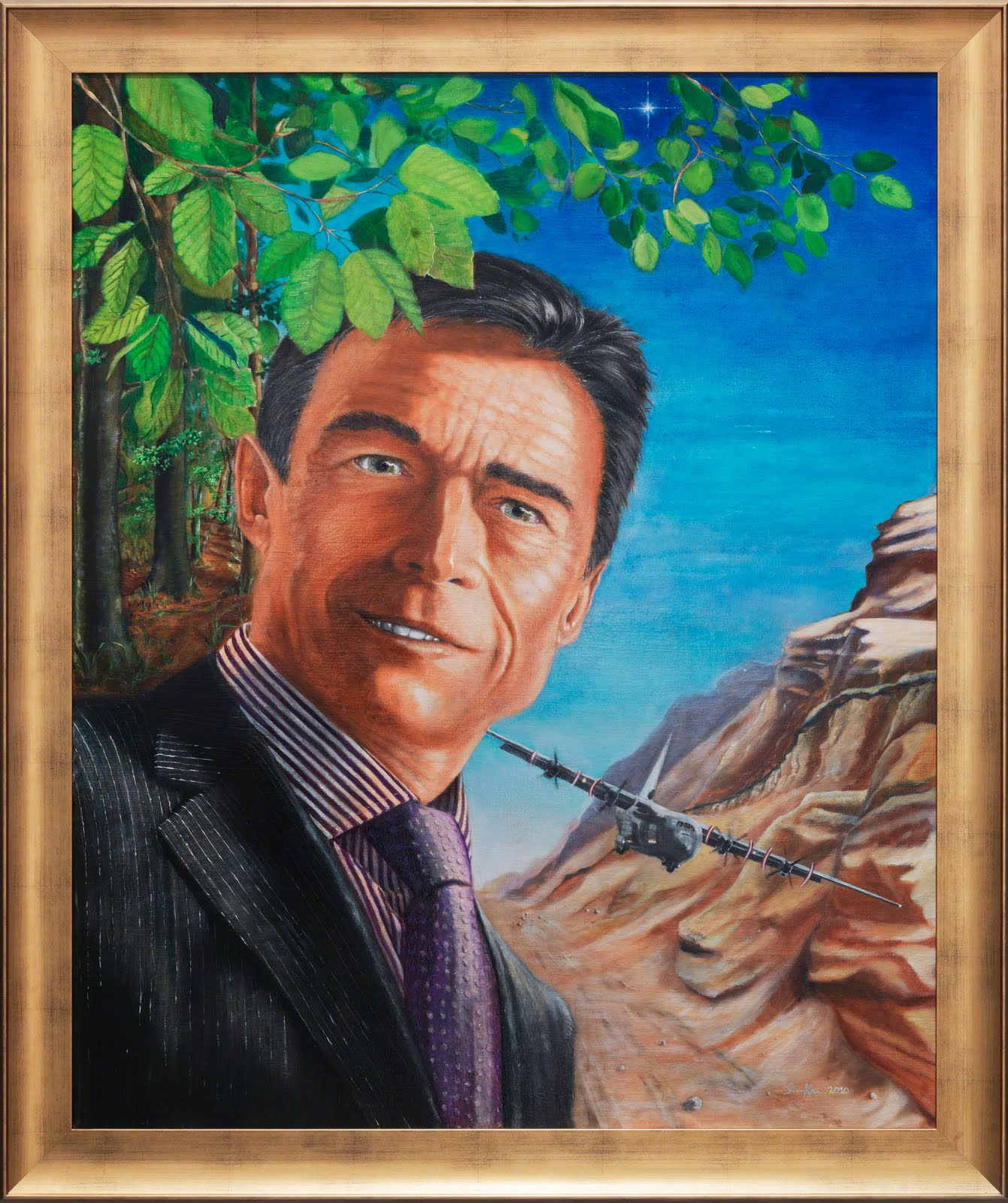
8 – Geopolitics. If resource wars kick off in Europe, and we can’t rule this out, then Denmark could well find itself in the firing line. This is not an enviable position to be in but the fact remains that Denmark to some extent still ‘owns’ Greenland. With various world powers eyeing Arctic oil and minerals, and even claiming ownership of the North Pole, it is unlikely that things will end up being agreed amiably over sherry. Should Denmark lay claim to Greenlandic oil, as it was suggested by Danish MPs on the morning news today, it would set itself up for a fight with Russia and perhaps China too. Hell, even Britain might claim a share. Yet it goes without saying that Russia could eat Denmark for breakfast, so without backing from, say, the United States (of which Denmark, like the UK, remains a client state) the country would have no chance of holding onto its prized possession. It can hardly be a coincidence that the ex-Danish prime minister, Anders Fogh Rasmussen, quit his role to take up the top post at NATO. 

Anders Fogh Rasmussen's self-commissioned portrait. What message is he trying to send out I wonder?

China, it might be added, has been having high level meetings with Denmark about Greenland and all the goodies that exist there. It has offered Denmark some pretty choice morsels in terms of trade pacts, with one of the most significant being the sale of fur coats to cater to China’s exploding requirement for bling. Incidentally, Denmark is one of the world’s leading producers of mink, fox and chinchilla fur. 

The UK, by comparison, having lost all of its huge mineral-rich overseas landmasses, will continue to struggle to make itself relevant – which is a good thing in my opinion. It has been a century since the British Empire began to collapse – more than enough time to get over it – and the country will likely revert back to what it once was, i.e. a group of soggy islands off the coast of northern Eurasia well suited to sheep farming. Of course, it will likely take a few centuries to get to that point, by which time I and everyone reading this will be long gone and some of my distant descendents may well be sheep herders.

9 – Population and carrying capacity. As mentioned above in ‘food’ both the UK and Denmark will eventually have to severely reduce numbers in order to live off the planet’s natural income as opposed to its energy inheritance. At present, people in both countries largely subsist on what William H. Catton calls ‘ghost acres’. These are invisible fields in far-off places where the food is artificially produced using oil – invisible to practically everyone who doesn’t want to contemplate them. As energy, the master resource, becomes less available, so will these ghost acres.

But before that happens we have to go through the next big financial shock, which could happen any month now. Nobody knows how long Europe’s politicians and bankers can keep shoving golden eggs down the goose’s throat, but when those same golden eggs stop appearing at the other end we can expect our standard of living to start resembling what ordinarily comes out of a goose’s backside. Many people will suddenly find themselves without the inclination to carry on and commit voluntary entropy, and some will achieve this semi-unwittingly with drink and drugs. More still will end up shivering/sweating in the cold /heat and a failing medical care infrastructure will suddenly reverse the increased longevity that we have been led to expect by the media. With social care systems collapsing we can expect to see the elderly being abandoned (some would argue that is already happening) as it becomes unaffordable for the system as a whole to look after them. Disease management systems will similarly be hit by cutbacks and viruses will have a field day.

But when the rubble has stopped bouncing after a few years we might find ourselves in a position of falling population as couples avoid conception, which commonly happens in collapsed societies. Unwittingly, we may already have entered this, as fertility rates have been falling for a long time and only expensive procedures, which will likely be unavailable in the future, currently allow infertile couples to have children.

10 – Preparedness/resilience. If all of what I have written above make you wonder why I’d want to stay in either country and put myself and my family through that risk, then this last point is the remaining element – hope – to emerge from Pandora’s box after all the other forces of chaos had been let loose.

It is my steadfast belief that people in the UK – or perhaps I should say some people in the UK – are better prepared mentally and physically than their Danish equivalents.  The Transition Town movement grew from the UK, although in reality people have been practicing low impact sustainable living for decades, and despite the hollowing out of industry many small scale artisans still remain below the radar. There is a growing web of food networks, local currencies and community energy projects and the assumption of many people in the UK is that they cannot trust the government to deliver vital services to them.  This, ironically, is a strength when compared with Denmark, where people are less empowered to take over their own livelihoods, and act timidly when it comes to going against the system. The assumption here is that the government always has their best interests at heart and that all solutions come down from the top.  Have you ever heard of Occupy Denmark? No, I thought not. In this respect, the conservative janteloven, which is supposed to protect society from radicals, may in fact be its Achilles heel. 

In the UK there is strong grassroots opposition to the coalition government and its suicidal plans to build more roads, airports, nuclear power stations and fracking wells. Overcrowded Britain, for better or worse, is a country of NIMBYs, making any new capital project that is perceived to be dangerous or ugly (or both) difficult or downright impossible. I certainly want to be there to play my part in helping to stop any suicidal growth projects that might be in the pipeline for my local area. Call me a de-growther, if you like. 

Finally, and although it might sound like a bit of cliché, I really believe that the concept of fairness and sharing is etched into the public conscience. Whenever disaster strikes we tend to stop grumbling about one another and pull together to get through it as best as we can. It takes practice to stiffen that upper lip. We have developed a warped sense of humour as a safety valve for life’s absurdities and horrors, and despite decades of media scare stories about the dangers of strangers the country is still packed to the gunwales with good Samaritans the charitable folk. Furthermore, there’s a growing sense of reverence for the natural world, a stirring of the spirit that urges us to protect the Earth in all of its diversity. Is this part of something bigger? We will have to wait and see on that one.

All of the above might look like a reductionist attempt to convince myself that buying a small forest in one of the outermost appendages of the country and learning the skills of a woodsman is a good idea. If it seems that way then it wasn’t supposed to be. Reductionism and rationalisation can both be dangerous pursuits and none of us can predict how the future will be and what our place within it will look like. All of us have to learn to embrace uncertainty and proceed with caution but retain good spirits and a sense of wonder at the world in all its complexity and all its awesome beauty. That, at least, is what I intend to do.