Wednesday, July 31, 2013

A House for the Future


It seems we're all at it now. Those of us dot-connectors who are concerned enough about the future to take action and relocate are scurrying across the face of the planet looking for somewhere we consider the odds might stack up in our favour a bit better than where we were before. Over at Resource Insights, Kurt Kobb can be seen relocating across the vastness of America to a new home in Oregon, the Doomstead Diner's RE went one step further and is now hiding out somewhere in Alaska and Ray Jason explains why he has taken to the high seas.

As for myself, I chose to take flight from the ostensible safe haven of Denmark and fling myself and my family to the furthest western reach of Britain - namely Penzance in Cornwall. I described my rationale behind the move here, and all I can say at present is that after four months here it feels like the right choice. I did, of course, buy a piece of woodland nearby, which is where I'm crafting my post-industrial career as a woodsman, with the first half acre of chestnut and oak to be coppiced this winter. At some point in the future, perhaps when planning regulations have drowned under their own weight, I'll build a nice little hobbit hole there. It'll be somewhere I can put me feet up and roast chestnuts as I eke out my non-retirement in as comfortable a manner as possible.

But that's future talk. Right now it makes more sense to be within a town, close to the children's school and also the shops. Which is why we've just completed the purchase of a house right in the centre of town.

Now, I would say that it's been quite a long and fraught process getting hold of this particular house. Not only did I have to take a major loss on otherwise stranded assets from our life in Spain, but I also had to negotiate several fraught months of having that money within the UK's increasingly fragile banking system, with a major risk of me being asked to bail out one of the TBTF banks with my savings. Nevertheless, the camel passed through the eye of the needle and I was able to spend pretty much every penny on a place that we can now call home and which we own 100% without even a penny of debt.

None of it would have been possible had my father not passed away last year, but I think he would approve of the fact that we have bought what he would term a 'fixer upper'. That is, the house is solid and the fundamentals are all in a good state, even if it needs something of an overhaul in various areas which I will list below. I'm only setting this out so that others may also start to think about what is important in a house fit for the future, and it's in no way an attempt to show off my abode as if I'm this week's  Through the Keyhole mystery person.

It's perfectly possible, if you have ownership of your own property, to live very simply and cheaply. These people here manage to do so - perhaps they are role models whom we should seek to emulate (as is Joan Pick). With that in mind my criteria for buying a house were relatively straightforward:

- It has to be built to last. Most houses built in Britain after the last world war were not built to last. The one we chose was put up at the end of the nineteenth century, is constructed from heavy granite, is standing on bedrock and shows no sign of it not being able to stand for another thousand years or so. The walls are thick and the foundations are solid.


- It had to be big enough to allow for different economic activities to be undertaken in it, but not so big that it would be unaffordable to heat or maintain. Ours has a basement which can be dug out some more and used as a workshop by my wife for her upholstery business, and  - joy of joys - an office space for me on the top floor. Furthermore, my assumption is that my kids will not be able to afford their own homes in the future, and that they'll be hanging around in our house far longer than is currently considered normal. With four floors, there should be space for us all.

Under the house

My new office. That old writing desk was rescued from a skip by my father in the late 70s
- It had to be close to amenities so that we can walk everywhere. Our house is a two-minute walk from the shops in the centre of Penzance. The town has pretty much everything you might want, from food stores and cafes, to a hardware store and a library. The hospital is a ten minute walk, the kids' school a five minute walk and the nearest pub is 98 seconds away (I timed it).

- It had to be easy to retrofit. One of the first things I will be doing is studying the central heating system and figuring out how I can get it running on wood fuel. I have two very heavy and antique wood-burning stoves from Scandinavia, which I salvaged, and which will be useful in our house as soon as I have disconnected the gas. At present all water heating is done by a dangerous-looking boiler in the basement which has a very large gas-guzzling pilot flame.

The boiler. To be replaced by a wood-burning stove with a water tank attached

I'll be looking to get water heating panels on the roof as soon as I can, and probably solar PV ones as well. At present the government is offering 'free' solar panels, although there are plenty of strings attached. I don't want to get into any debt, but nevertheless may take them up on this offer given that we have no more funds to finance things like that. The house is aligned north to south, meaning the morning sun heats up the back and the afternoon sun hits the front.

There is a carport at the back, big enough for two cars. My plan is to rip up a lot of the concrete and plant a small garden here. There's also a tiny garden at the front, which will probably just remain ornamental, perhaps with these coffee bushes (the house next door has bananas - everything seems to grow here).

Some coffee bushes and olive seedlings I picked up

The carport - just the right size to make a small enclosed garden


There are, of course, a whole lot of other factors that I need to take into account - especially insulation. But it is a terraced house, meaning that heat is not lost on either side, and the huge thermal mass of the walls at the front and back should be handy for keeping it warm in winter and cool in summer.

- It had to be above sea level. At 40m, up a steep hill from the sea (which is about half a mile away) I'm not too worried about sea level rise and storm surges just yet.

- It had to be affordable. This is one reason to choose the far west of Cornwall. Although house prices are still inflated by the bubble, this is one of the more affordable areas of the UK. Our budget was £200,000, which is about £40,000 less than the average house price. This is still an outrageously high amount by historical standards, and I'm fully aware (and grateful) that by some good fortune we had the money for it.

This alcove should be good for stacking wood in

- It had to be located in a good economic community. Penzance is a smallish market town with excellent trade links. The nearby railway station offers services to London, and everywhere in between, which is why the town thrived in Victorian times as fresh fish and flowers were sent daily to the capital, and tourists flowed in the other direction. Penzance is also a port, and it is easy to get to nearby France and Ireland. The house we have bought was most likely built by a merchant from those times. Given that I presume we will be rewinding the clock and going back to an economic model that will look a lot more like Victorian England than the current fantasy-based economic model, this can only be a good thing.

As you can see from some of the pictures I have included, I have a wealth of junk that needs sorting through. My several years' dumpster diving in Denmark mean I have a lot of nice old furniture, plus several thousand books and enough old but functional tools to set up a second hand hardware store. It will seem incredible in years to come that I was able to come by all of this stuff for nothing - or almost nothing. In total, I have five large trailer-loads full of 'stuff' - two of which are still in far-flung corners of Europe (another Spanish adventure awaits next month), which is the culmination of at least four lifetimes. And even then we are still lacking such basics as a sofa and mattresses - although I'm certain I can get hold of these from Freecycle in the coming weeks.


And below is the view from my new office window which looks out over Mount's Bay to St Michael's Mount. It beats sitting in the kitchen staring at a white wall, which I have been doing the past few years writing this blog, but it remains to be seen whether I'll be able to stop looking at it and actually get some work done.


So that sums up our new abode. It's been a long and winding journey to get here and it's emptied the coffers but - as Dmitry Orlov notes - we're going to lose our money anyway, it's up to us to choose the manner in which we do so. And that's just what I've done. I have no debt, no pension fund to look forward to, no stocks or shares, no precious metals hidden away and very little cash and no permanent job - but what I do have is a house that is suitable for living in and earning money from into the far future and that, in my opinion, represents a store of real wealth.

Sunday, July 21, 2013

Melting Britain


This morning I awoke to the sound of a strange noise coming in through the open windows of the house. To my half-asleep ears it was a whooshing, rustling sound, as if thousands of people were stood around outside the house all screwing up balls of paper with their hands. A clap of thunder brought me to my senses and I leaped out of bed to close the windows, which have been permanently open for the last couple of weeks, just as the sheets of monsoon-like rain began to torrent down from a cotton wool sky.

Yes, Britain is experiencing something of a heatwave at present and has just had the hottest July weekend in years, and this sudden welcome gush of rain looks set to provide only a momentary respite. It only fell for about ten minutes, but it was long enough to wash the dust off the cars and give the local foliage a much-needed drink. However forecasters say that next week temperatures will be even hotter. So far they have touched the low 30s (around 90F), which is more than hot enough for most people here who are more used to damp and soggy weather.

If temperatures do rise to 35C (95F) next week, as is predicted, we can expect to hear many more warnings from the government about the dangers of extreme heat. Already, it is estimated, at least 760 people have died who would still be alive were it not for the heat. Yes, most of them were elderly or in poor health, and were unable to find somewhere to cool off (air conditioning is almost unheard of in Britain). Internet boards are full of scoffing Australians and Texans, saying that 30 odd degrees of heat is practically chilly to them - but then weather is all about what people are acclimatised to (I've seen people from hot countries practically die in Scandinavian winters in which I could get away with wearing a thin sweater). It’d be gallows humour to point out that some of the only remaining cold rooms to be found in the UK are within municipal morgues at present.

Particularly at risk are people who live in high rise tower blocks, which trap heat during the long days. This heat rises and builds on the upper floors, and the nights are too short to allow much of it to escape before the merciless sun is up yet again. It’s just one example of infrastructure that isn’t fit for purpose and was never designed to cope with conditions outside a narrow range of possibilities. Similarly, there are reports of melting roads in Cambridge, outbreaks of grass fires across London and low water pressure caused by people wasting it by keeping their lawn sprinklers on all night.

I am just old enough to remember the summer of 1976, which was the last really hot summer this country experienced. Below is a picture of the five-year-old me (dressed as a wizard) in the Banbury carnival. Minutes after this picture was taken I fainted in the heat and had to be carried away by paramedics (note to self: don’t wear a black wizard gown and hat in suffocating heat). Around the country at that time people were finding their water supplies cut off and lines developed at rapidly erected standpipes on street corners. It was hot alright.


So although extreme weather events are nothing new it is the increased frequency of their occurrences that is the obvious effect of global weirding we are now starting to experience. We’ve just been through the coldest spring in living memory, which followed hot on the heels of the wettest summer. A friend in southern France reports that a month ago it was only 10C there, when it should be more like 30C. Germany has just recovered from mass flooding, the Arctic ice is melting at record rates - one can go on and on about the weird climatic conditions that are now prevailing across the globe. 

So what are we, in Britain at least, doing about this very obvious climate change? Here, unlike in the US, people at least say they take anthropogenic global warming seriously. Despite repeated attacks by various well-funded lobby groups through such organs as the Daily Telegraph, most people believe we are in deep trouble, albeit trouble that is far off enough not to have to worry about just yet. 

But the government doesn’t seem concerned in the least. Not only are there efforts to stop climate change being taught in schools, but the chancellor just announced that fracking companies will face the historically lowest taxes on record for any fossil energy producer. This, we are told, is to kickstart the revolution in shale gas fracking - a revolution that IMO if it goes ahead is likely to lead to the closest we have come to all-out civil war in this country since the 17th century. 

The reasoning behind this is simple enough; to drill enough well heads to produce even a modest flow of gas we would have to drill literally thousands of wells in the northwest alone. This would be in people’s back yards, on farming land and in areas that are naturally beautiful. The only feasible way that this could ever happen is if the government takes control of land and property on a grand scale, and it would need a very large security force to do that. In the process groundwater would be polluted by the fracking chemicals and much of the remaining North Sea energy would be wasted in trying to make this very low EROEI energy look attractive. It's a recipe for disaster, but it's also a price that many people seem willing to pay given the drum-beat of hype that is pouring forth from politicians and the media.

The only real hope in this scenario is that the American fracking sham comes visibly apart at the seams within the next couple of years. The resulting shock will strangle the UK’s nascent fracking industry at birth before it gets a chance to irreparably pollute the aquifers and cause much bloodshed. It’s a race against time.

And let’s not forget that the UK is running out of water. The intensely wasteful use of water in agriculture is estimated to only have a few years left in it and 'peak water' is on the cards. Future warming, such as we are experiencing right now, is putting a huge strain on water resources and scientists reckon that we are only a few years off putting ourselves into a permanent drought situation that will see crops shrivelling in the fields beneath a super hot sun. 

Of course, there are many ways to conserve water - the most obvious of which is to grow crops biodynamically and restore as much moisture retaining topsoil as possible, but I haven’t heard anyone in a position of importance talking about these measures. Indeed, this kind of overshoot is a blind spot for the growthaholics, and shouldn’t be allowed to interfere with business as usual. The solution - as ever - is to import more ‘stuff’ (food, water, oil) from the global marketplace, wherever that is, and that technological solutions will be found for the most pressing of problems. The assumption here is that the UK will continue to remain a wealthy country far into the future and that foreign markets will be able to provide all of the commodities and energy we desire - all at a favourable price - and that technology is the goose that keeps on laying the golden eggs whenever we need it to.

Alas, this kind of non-thinking is delusional and dangerous. We are being promised a future that we can’t afford and only a very small fraction of people realise the severity of the creeping problems which are now beginning to consume us. There is no way out of our predicament while this kind of blindness persists. We are fated to collide with overshoot like a car hitting a brick wall, and all we seem to be able to do is push our foot down further on the accelerator and scream ‘yee ha’ as we do it. It’s not a pleasant thought, but then 22 Billion Energy Slaves trades in unpleasant truths rather that comforting fantasies. If we want to get a taste of how the UK will be in 20 years then have a good look at Egypt.

The heat is on!

Tuesday, July 9, 2013

Dumbstruck


“Does Andy Murray winning Wimbledon mean that we are headed for the economic good times again?” asked pretty much every news outlet in Britain yesterday. We were even treated to an ebullient Jon Snow on Channel 4 News prancing around on London’s Primrose Hill in the summer evening sun asking bemused onlookers whether their consumer confidence had improved over the last 48 hours (to their credit they all looked baffled by the question, perhaps suggesting that those who live in the media-land bubble should get out more).

But the headlines keep coming thick and fast. Here in Britain we are told that a house price boom is on the way. But if that’s the case then who’s buying? It certainly isn’t the kind of people for which owning a house would be rather useful, say, young people starting up a family. Instead, demand seems to be driven by the increasingly ubiquitous buy-to-let landlords, keen to make a killing out of a desperate situation. Some of these ‘ordinary people’ have amassed hundreds - even thousands - of properties, which they let out to those unable to afford their own. One recently boasted that he ‘earned’ £35,000 a week, meaning he could go on and buy a few hundred more properties and become even wealthier.

Presumably some algorithm somewhere has decided that I might be a good BTL landlord as I keep receiving emails from companies wanting to make me rich. But given that so many people are now being forced into usually sub-standard accommodation, presided over by a rentier class indifferent to their plight I find myself wondering when the day will come when landlord killing becomes a fashionable sport again. Britain might be running out of money, but there are still plenty of lampposts and miles of rope. 

Although, whenever I express sentiments like the one above I am inevitably accused of being gloomy, or depressive or, worst of all, boring. I have to say, it’s hardly a barrel of laughs pointing out repeatedly the emperor’s lack of clothing, and sometimes I’m tempted to just stop typing this stuff and get with the programme. You know, perhaps economics can be sentiment based - perhaps scientists will come up with that wonder fuel after all, and maybe those climate scientists who say it’s one minute to midnight really are just after a new research grant. Comforting thoughts indeed.

But then the fundamentals come screaming back at you and you can’t tie your tongue. Schadenfreude is a horrible word, and not just because it’s difficult to say (or spell). What makes it even worse is the fact that you can raise your voice as loud as you can, and even when you are proved repeatedly right, most people won’t accept the truth of what’s in front of their noses. That seemingly apparent truth is that the age of limits is upon us, not that you’d know it from the media and all the assorted ‘experts’ who are wheeled out of their ivory cubicles to pontificate on topics concerning the future.

We are apparently in an economic recovery. The US jobs market is booming, and Chinese people now all own at least one BMW.

Never mind the ‘fundamentals’, such as the velocity and supply of money - that is money in the ‘real’ economy away from QE. Here’s a chart put up by The Automatic Earth:


In this case it is looking at the US and that supposed ‘boom’ that they are having over there. Yes, there’s a boom going on alright as the chart shows - a boom in government credit creation that is being transferred more or less directly into the coffers of the biggest investment banks for them to sit on and do nothing with. This is money that current and future generations of Americans now owe the government. And the velocity of money - that is, the speed at which it travels around the economy from one hand to the next - is also experiencing a massive boom - if you turn the chart upside down.

But, hey, back in Britain again we will all soon be sitting in driverless cars designed by Google (never mind that the government is running out of money to fix the potholes in the roads). And the next big boom area is the fusion of biotech and robotics where ‘the line between human and robot will become blurred’. And by genetically engineering crops and handing over their ‘patents’ to corporations we ‘will cure world hunger’. Obama has vowed to ‘light up Africa’s darkness’ by electrifying the continent. Ten billion people on planet Earth is 'not a problem'. 

I don’t know about you but this maelstrom of voices is starting to make me dizzy. Perhaps I should just tune off and live in a cave, as an increasing number of people seem to be doing.

But what is really confounding is the sheer amount of misinformation out there that somehow possesses the almost magical ability to coalesce into ‘fact’. Perhaps it’s just a result of our over-complex society and will go away in due course. Thus, we are told that fracking gas in Britain will give us enough energy for 100 years. Fact. No argument. No dissent permitted. 

Mention the very real limits which make this pipe dream unachievable and you are inevitably accused of being overly negative. But I can now see quite clearly how events are shaping up in Britain and how we will go down screaming and battling one another as the dead weight of entropy pulls us beneath the waves. The problem is, we are literally running out of the kind of energy flows we need to make a modern industrial economy tick over. North Sea oil and gas is dropping like a rock, wind and solar are frankly useless for anything other than small scale applications, nuclear is a giant sickly radioactive white elephant that is running out of current buns, and any other energy source that you care to think of is so riddled with problems that it beggars belief that people buy into it.

But, hey, seaweed will save the world, according to the Guardian.

But as the needle on Britain’s fuel gauge hovers ever closer to the orange area I wonder what the reaction from the population at large will be when the lights literally do go out - as we were warned would happen by 2015 by no less than the energy regulator Ofgem a couple of weeks ago. Will people say ‘Oh well, it was nice having fossil powered energy while it lasted but now I’ll just trade in my Ford Fiesta for a donkey, get a job as a day labourer on a farm and tell the kids that they’ll have an even harder time of it than me.” Or will they scream blue murder at the politicians and energy companies, march en masse through the streets and elect a wide-eyed militant loony who promises to ‘restore Britain’s glory’?

Predictably, the news about the increased risk of blackouts in 2015 was met with a barrage of denial by politicians and industrialists. “The lights will not be going out,” was the peeved response. There was a subtext to that response, of course, and the subtext was ‘Unless we let them go out by not fracking the life out of the country, letting the French and Chinese build a new generation of nuclear power station and opening up some of the coal mines that Maggie shut down because they were so hard to get the coal out of. Indeed all we have to do is try harder to keep the lights on - if we all join hands, scrunch up our eyes and shout at the top of our voices:

The lights are going to stay on! 
The lights are going to stay on!
We refuse to recognise the legitimacy of the laws of thermodynamics!
We are too clever to sit in the dark! 
Our way of life is not negotiable!

That should do the trick.

Wednesday, July 3, 2013

Banker-spotting with Bill Oddie

For those of you who don't know, Bill Oddie is Britain's most famous bird watcher, and was once quite a funny comedian. In this clip he goes deep into dangerous territory in search of 'the most dangerous animal on the face of the planet' and is on the receiving end of some hostile, territorial behaviour.


Wednesday, June 19, 2013

The Foxtrot Collapse

Salvador Dali's 1957 'Dance' 


There’s always a lot of discussion on peak oil forums about whether the decline of industrial civilzation will take the form of a vertiginous descent, or whether it will be something long and grinding that will be measured in decades and centuries rather than years or months. In the fast-collapse camp are the likes of Dmitry Orlov (who bases his assessment on his experience of seeing the USSR implode) and Ugo Bardi, who expects a ‘Seneca’s Cliff’ dropoff. James Kunstler, Michael Ruppert and any number of others can probably also be added to the fast-collapse camp.

By comparison, the likes of John Michael Greer reckon we are in for a drawn-out era of terminal decline punctuated by serious crises which, at the time, will seem rather severe to all involved but which will give way to plateaux of relative stability, albeit at a lower level of energy throughput. At the end of this process we will be back to something resembling the Middle Ages, with smoking nuclear power plant dead-zones. His basis for this is a study of history, and in particular the work of writers such as Arnold Toynbee, Oswald Spengler and Joseph Tainter, whose books emphasised the cyclical nature of all civilizations  These, they assert, can  be seen to go progress serially through stages of ebullient expansion, cultural dynamism, acquisition  entropy, overshoot, decay and eventual collapse. Our current industrial civilization, he argues, is but the latest in a long line of civilizations shuffling slowly towards the global compost bin.

But is it? Many would argue that scale matters and that today’s too-big-to-fail hyper-complex, bisophere changing civilization is such a different kettle of fish to its predecessors that when it enters the overshoot and collapse phase, as can be observed to be happening right now, the resulting calamity will be on a scale never before seen or experienced. All buildings fall down eventually, but would you rather be standing next to a fisherman’s cottage or a skyscraper when that happens?

In addition to these criticisms, some would point out that today’s global economy, aided and abetted by instant communications, is far more prone to cascading collapses, in which one strand in the web breaking leads to the whole web being destroyed. A bank collapse in China, for example, could lead to other banks seizing up and cause commerce to freeze as notes of credit go unwritten. By comparison, a mercantile trader in 15th century Venice would not have known that the bond guaranteeing his cargo was worthless for up to several months following the bankruptcy of a creditor, and trade would have carried on as normal in the interim. Inefficient communications, in this case, meant resilience.

Anyway, all the talk about fast collapse/slow collapse can seem a bit like fiddling while Rome burns. The simple facts of the matter are that we have exhausted all of the cheap energy options available to us, which is causing the global financial system - an entirely fabricated construct that can only run on blind optimism, greed and political largesse - to exist in a state of total crisis. Virtually every large economy in the world is facing up to its own pet crisis, although the scope and nature of each one is quite different. Europe is mired in unpayable debt, the US is addicted to pumping illusory ‘money’ via the Print button on the Fed’s keyboard and is just starting to realise there is no way back down the ladder, China’s gargantuan credit bubble is deflating, Japan is playing Russian roulette, and commodity producing countries such as Brazil and Australia are reeling from lowering demand from formerly insatiable importers. This is not just part of the business cycle as most talking heads assert.

It does seem quite likely that we are facing an uber Minsky Moment - that moment where investors realise their assets are vastly over-valued and stampede for the door. But where will they stampede to? The US dollar and world stock markets look like safeish havens for the time being to many, which would explain the Dow Jones’ and FTSE’s phenomenal head-scratching rises in recent weeks. Precious metals and land are being snapped up, especially by China which wants to simultaneously dump risky American assets and build a global network of agricultural land to feed its too-late-to-the-game middle class consumers (leaving ravaged ecosystems and raging mobs of dispossessed people in their wake). It’s a game where the stakes keep getting higher and higher with every passing week.

But the planet, of which our human economy is simply one small subset of, is a complex system to say the least, and complex systems are difficult to break all in one go. That’s why in my opinion collapse will not come about in a neatly linear fashion, but will be of a stop-start nature, like a badly-maintained fairground ride with a sadistic teenage operator. Of course, when I say the word ‘collapse’ I am mostly talking about the impacts it will have on the lives of we who live in the ‘West’ - most countries and people in the world have been living with collapse for centuries. Try telling a Malawian subsistence farmer that we may be in for a bumpy ride and see how he responds.

As has been noted before, global financial collapse is likely to be the first step, and that could happen overnight. Hot on its heels will be commercial collapse and a very sustained period of, shall we say, discomfort. Political collapse, as well as the rule of law, are next up on the Magical Mystery Collapse Tour, and we can only pray that we don’t get to social collapse too soon.

But all of these will take time. There will be grey areas and stages that overlap one another. Some locations will be worse off than others that might be just down the road, and some regions and countries might get lucky and find they are suddenly in a far better position than they were previously. Indeed, the whole thing will bloom like a fractal - or should I say is blooming like a fractal because we are already several years into this adventure. Individuals, communities, families, governments, militaries, religious groups and organised crime syndicates will all have their roles to play as the game changes, and only those most able to adapt to the ever-changing circumstances, or just the downright lucky, will be in a position to see the next stage of collapse.

Some stages are likely to be faster than others. The collapse of credit availability, insurance and investor confidence will be more or less instanteous once the first big domino falls, but national currencies, cooperative arrangements and various forms of trade will no doubt linger on for some time. Commerce is complex, with some supply chains being more fragile than others, so we’re likely to see the availability of most high tech items severely curtailed, while more basic items that don’t have to be shipped halfway across the globe and rely on several hundred individual suppliers, will be available for longer. Rationing will prolong the agony and the black market will step in as people get used to the idea that things are not as they used to be. 

So, for most of us I expect to see collapse happening at different rates. Sometimes they will be fast and brutal, and other times they will be slow and unnoticeable to those concerned until viewed in the rear view mirror of history. It’ll be a case of slow-slow-quick-quick-slow - which we might as well call a foxtrot collapse, after the ballroom dance with the same moves. 

I’m sure that, when all is said and done, nearly all of those in the reality-based community who regularly write about peak oil, civilizational decline and environmental crisis (with the exception of the Near Term Human Extincion folks) would agree that collapse occurrs by stages and it is merely our own standpoints which determine how direcly we are affected and when. After all, a credit meltdown could seem like Armageddon to a Hong Kong banker, but would barely even register as news to someone living a sustainable life on an island in Greece. Conversely freaky weather caused by climate change could destroy the Greek islander’s livelihood, but the banker, unaware of the natural elements outside his air-conditioned trading floor, would not even notice.

Becoming aware of the proximity of the stages of collapse should be a priority for individuals and governments alike, but for a multitude of human reasons this is not the case. Nevertheless, if you’re reading this then you’re probably also one of ‘the choir’ and are acutely aware of all the mounting problems that we face. It’s a catch 22 situation, aided and abetted by most media, which are desperately blinkered when it comes to nebulous predicamants, and keen to focus on blaming individual people for their follies. Oh, and it doesn't help shift advertising space.

So for the time being we have blogs to use as communication tools, although when they are gone one day we might be back to the days of printed mailing lists and subscriber magazines and journals. In fact, I think I’ve already come up with one ...The Entropy Times - your daily dose of doom

You heard about it here first.

***
By the way - this is my 100th post. I can't believe I have actually got this far with this blog, and further can't believe that there are some 10,000 page views a month (although probably at least half are robots/government spies/friends checking that I am still batty). I'm thinking about actually trying to earn a few pennies from my endeavours and writing a book, making it available to buy from this site. It already has a working title - Mind the Vortex - How to Survive the 21st Century - but I'd be interested to hear if anyone thinks this is a good idea or a bad one. With all the work I am doing over at Fox Wood (this week I dug a humungous hole by hand and cleared half an acre of brambles with a sickle) I could do with a project that doesn't involve getting covered in mud and coming home with bleeding forearms and blistered hands. 

Thanks for reading 22 Billion Energy Slaves!

Monday, June 10, 2013

Up the Amazon on a Camel


Amazon rainforest cleared for soy production 

One unintended consequence of GMO and monoculture crops is the desertification of some of the most bio-intense regions on Earth. This guest post by Ray Neary explains more.

I don't normally do guest posts, but Ray and I go back a long way and went to school together and rode the rails around Europe as teenagers. These days Ray practices permaculture in the French Pyrenees and writes about GMO. See Monsanto Roundup Resistance for more info.


***

Camel riding isn't what you'd describe as a typical Amazonian tourist activity, but it might be a lot closer to becoming a reality than you imagine. We might not yet be surfing down the dunes of the Amazon basin, but the days of canoe trips up endless rivers through dense jungle are well and truly numbered. The only things that are endless in some parts of Brazil now are the soya plantations, and with three harvests a year they are very thirsty. Not only is the water disappearing as fast as the trees vanished, but the soil is too, now that there is nothing left to protect it.

On average for every kilo of food produced by the globalised food chain we have lost six kilos of soil. A kilo of cooked ham from a pig fed GM soya from Brazil has used 3,500 litres of water. Of course the majority of that production is bound for Europe and North America. Even though the majority of the charge falls on the food giants like Monsanto, Dow AgroSciences, ADM and Cargill, we also have a part of the responsibility for having allowed (and sponsored with our taxes) the globalisation of the food chain; we also have the responsibility to change things.

So while the world will be celebrating the feast of football that the World Cup in Brazil promises, we have to face the reality that if we continue as we are one day soon the only green things left in Brazil will be the football pitches. In some parts of Brazil fetching water has become the principal time consuming activity, just like in certain better known desertified regions including East Africa. Now there is also a growing problem of migration towards the slums of Sao Paulo as subsistence farmers are forced off their land.

It's a phenomenon unknown to many, yet it threatens almost half of the world's remaining land, and most of the worlds farmland. We've already almost turned half the world to desert - the barren Middle East was once called the 'fertile crescent'. It's called desertification and is incontestably the prevailing sign that our modern farming techniques are far from sustainable. If left unchecked its effects are disastrous. In Brazil we are witnessing the desertification of an area the equivalent in size to the surface of France and Germany combined, and purely due to deforestation, slash and burn destructive agricultural techniques and excessive ploughing. Sometimes in Brazil it takes as little as five years to transform woodland into desert.

This is not just happening to Brazil, it's happening to all the forests and farmlands of the world, even places considered traditionally to have green fertile farmland such as France are showing alarming signs of desertification. It doesn't have to be that way. Studies show that we are capable of feeding the world for future generations organically, without cutting down any more trees and even letting some grow back. 
In some areas of Brazil the desertification is being fought by using low-cost and ancient techniques, including constructing swales for water retention, and planting trees.

By doing this we might hope to save some rainforest - but that's not all we'd achieve, in doing so we'd reduce pollution, create humus that fixes carbon, increase the world's forests' potential to balance our carbon emissions, create jobs, provide healthier food, save energy and reduce emissions, have cleaner water (or still actually have some water), really start fighting hunger, improve living conditions for billions of people, reduce developing countries' dependence on providing cheap labour and resources or being forced into debt - indeed, what is there not to like, unless you are a corporation?

There have been many successful projects where desertification has been reversed. These are grass roots projects that have not involved the global giants of agribusiness; from South America to Africa, and China to the Middle East successful projects have been shown to work. Sustainable and regenerative projects, using principles like permaculture, are working with and improving not only the fertility and therefore the local ecology and biodiversity, but also living standards and animal welfare. 


Producing food locally with less energy limits waste, ends the speculation on food prices and limits the indexation of food prices with commodities such as oil - all of which lead to the instability of world food prices and elevated insecurity for poor communities and the tensions that creates. This is a distinct reality and we could be re-greening deserts the world over instead of creating them.

We don't need GMOs, we don't need intensive mono crops, we don't need to deforest the planet to feed the world, we just need better management, or even simply less “management”. Individually we can start making a difference today by thinking about what we eat and its consequences, and by getting more informed about where your food is coming from. If possible grow your own food (and teach the kids to as well) either in your back garden or by joining or starting a local community garden or free food initiative like Incredible Edible. When you buy food get organic and local or Fair Trade for imported goods. Boycott GMO, non-sustainable farming products, prepared food and the globalised food chain - your lives and those of many others depend on it.

by Ray Neary for Roundup Resistance 

Sunday, May 19, 2013

Making an Iota of Difference

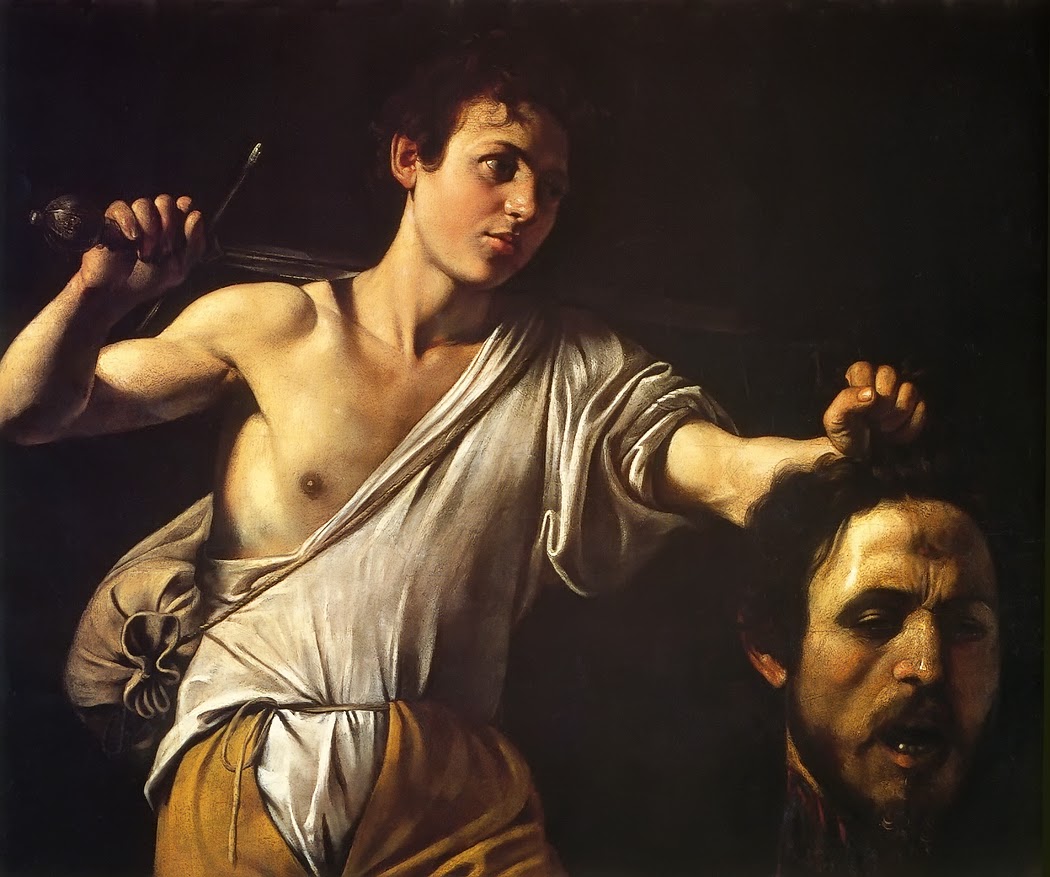
Carvaggio's David and Goliath

Iota: noun

  • The ninth letter of the Greek alphabet (Ιι), transliterated as ‘i’.
  • [in singularusually with negative] an extremely small amount:nothing she said seemed to make an iota of difference


Yesterday evening I attended a talk by a man who lives in the nearby village of Mousehole. The talk was about creating sustainable communities - whatever they are - and was given by Anu van Warmelo. It took place in a Penzance venue called Open Shed, which is a kind of cafe where you can get your laptop or sewing machine refurbished and your bike repaired while you sip on a latte and flick through the latest issue of Resurgence. It's exactly the kind of place that I had been missing during my years in Denmark and, I was to learn, the kind of participatory open place where you can chat with the locals that's been heading towards extinction in recent years.

The talk seemed to get a good reception from the 20 or so of us in there, perched as we were on skip-rescued sofas and a farrago of old chairs. Despite the talk being called Creating Sustainable Communities the focus wasn't really on this, more it was an exposition of what makes certain communities and aspects of these communities more likely to be resilient in the face of change.

Some surprising examples of resilient communities were illustrated, and you can be sure that none of them were suburban tracts surrounding giant mega cities. American trailer parks, for example, could be seen as the ultimate in adaptive and resilient communities. You can move your trailer around at will (to escape bad neighbours or just for the hell of it) and when your daughter grows up she can buy her own trailer and plonk it next door to your own. Slums were also cited as places with masses of social capital in the absence of financial capital.

I was less sure of his example of Beverley Hills being a resilient community by sheer dint of the narrow world view of its denizens, comparable to a medieval village where nobody travels much and is disinterested in the wider world. Maybe it was meant as a joke.

Anyway, it was a thought provoking talk and it reconfirmed my prejudice that I'm now living in an area that will likely fare much better than other regions of the UK and beyond over the next century.

Afterwards there were questions and one man vented his frustration that despite all of his efforts to live sustainably over the years it has not made 'one iota of difference' to the status quo. Massive corporations with giant PR budgets were riding roughshod over the planet in an orgy of destruction, he said, and there was nothing - nothing! - that we mere individuals could do that would have the slightest effect.

Activism has its place
I had to disagree. Not because I'm a naive clicktivist or placard waver who thinks that we can 'make politicians listen' while retaining our own comfy life styles - I'm not. Instead I believe that we will never know the direct result of our actions, most of which are too miniscule to be noticed on the micro level, but which can add up at the macro level and induce tipping points.

But just because they are minuscule doesn't mean they don't add up. After all, if Rosa Parks had chosen to stand up on that bus in 1955, black people in America might not enjoy the same civil liberties (or lack thereof) that everyone else enjoys in the United States. She could not have foreseen the outcome of this, moments before she parked her stubborn backside on that seat, but the subsequent furore was the spark that ignited a civil rights movement. Parks later wrote:

"People always say that I didn't give up my seat because I was tired, but that isn't true. I was not tired physically, or no more tired than I usually was at the end of a working day. I was not old, although some people have an image of me as being old then. I was forty-two. No, the only tired I was, was tired of giving in."

I can well appreciate that people in the environmental movement are tired of fighting against all that is wrong and destructive, and I know full well that some people burn themselves out in the process and become cynical and bitter. With large parts of the once-idealistic movement having been co-opted by 'the machine' is it any wonder that there's a distinct lack of hope?

But then, if everyone had adopted the 'it doesn't make one iota of difference' approach then would we have seen the recent banning of neonicotinoid chemicals by the EU? What about the far from perfect but still a step in the right direction decision to substantially scale back discarding fish by fishermen? There are plenty of examples, big and small.

Corporations don't rule the world, physics does
But in terms of the whole 'corporations rule the world so why bother' meme, I couldn't disagree more. Yes, corporations are too big and out of control - that's what happens when you let Big Capital grow too large. That does not mean they are omnipotent. They are still subject to the physicals laws of the universe, and they are very vulnerable to collapse. What's more, they are also very vulnerable to politics - let's not forget that politicians will always save their own necks before someone else's - even if that 'person' is a corporation. Just this year we have seen Tesco halted in its seemingly world-conquering expansion. It has abandoned stores in the USA, its profits are down and many of its customers have left to find something even cheaper and nastier (by the way, my first ever job was as a Tesco shelf-stacker at its first ever megastore, built on an irreplaceable SSI at a wildflower meadow just outside of Solihull).


Gandhi said that however feeble his own efforts seemed he slept safe in the knowledge that all empires, however mighty, will one day be no more. It seemed inconceivable when he said this about the British empire - but now look at it. To misquote another great philosopher, Adrian Mole, "I couldn't find Britain's remaining imperial possessions [the Falkland Islands] on the big world map spread out on the kitchen table until I discovered them underneath a cake crumb that Nan had dropped."


Industrial civilisation is also an empire. But it's not an empire built on ideology (are any?) but on the sheer logic and dynamics of the flows of cheap and abundant fossil fuels.  And peak oil means that big, increasingly, does not mean better. Big has become too big as in too big to fail. And if something is too big to fail there's a problem with the system because it means it will take down the whole edifice when it inevitably does fail.

On being a small furry rodent
So, sustainable communities, to me, means keeping out of the way of things that are too big to fail. A falling dinosaur can crush a lot of small furry rodents when it topples. In practice this means meeting people face to face (and not just online), about doing the things that you know are right with the materials, space and resources that you have at hand (however puny you might think these may be), about avoiding suicidal financial systems, getting a grip on your food supply and keeping yourself sane and healthy in the process. It also means linking up with like-minded people and trying to avoid spending too much time with those who have become too emotionally invested in business as usual.

Liquid lions teeth
This morning, after I've written this, I'm heading out to a traffic roundabout just down the road from here. I noticed yesterday that it was covered in yellow dandelion flowers. Perhaps it's just me but I immediately thought 'dandelion wine'! I'll use one of the demijohns I found in my father's attic after he died, and will take great joy in watching it ferment away and make plopping noises in the airing cupboard. At the end of it all I'll have several bottles of my own wine and the GDP and CO2 output of Europe will go an infinitesimal notch lower because I have not purchased any bottles of wine from Italy or France. Granted, it's not going to bring the supermarket system to a skidding halt, but it will make precisely one iota of difference.